
TL;DR:
- Over 90% of UAE patients now prefer non-surgical skin tightening treatments for safety and convenience.
- UAE's strict regulations ensure high safety standards with FDA-approved technology and licensed practitioners.
- Non-surgical options offer lasting results, lower costs, and are suitable for diverse skin types across the UAE.
Over 90% of patients seeking skin tightening in UAE clinics now opt for non-surgical treatments over surgery. That number surprises most people who still assume a scalpel is the only path to real results. The truth is that today's non-surgical options deliver measurable, lasting improvements with far less risk, zero downtime in many cases, and price points that make sense for everyday life in Sharjah and the UAE. This article walks you through the science, the safety standards, the real costs, and the honest limitations so you can make a confident, informed decision.
Table of Contents
- Understanding non-surgical treatments: Methods and science
- Safety and regulations in the UAE: What sets non-surgical apart
- Results, affordability, and suitability: What patients experience
- Limitations, maintenance, and expert guidance: Making the right choice
- A fresh perspective: The hidden strengths of non-surgical care in the UAE
- Expert non-surgical treatments in Sharjah: Next steps
- Frequently asked questions
Key Takeaways
| Point | Details |
|---|---|
| Safe, regulated care | Non-surgical treatments in the UAE are tightly regulated, offering reliable safety with FDA-approved devices. |
| Proven effectiveness | Patients see up to 93% improvement in skin tightening and rejuvenation, with high satisfaction rates. |
| All skin types welcome | Modern technology delivers results for every skin tone, ideal for Sharjah’s multicultural population. |
| Affordable beauty | Costs are significantly lower than surgical options, with minimal downtime and hospital fees. |
| Better with expert guidance | Consult DHA-licensed professionals for tailored multi-modality plans and ongoing maintenance. |
Understanding non-surgical treatments: Methods and science
Non-surgical cosmetic treatments use energy-based devices and injectable compounds to stimulate your skin from within, without cutting or removing tissue. The core idea is elegant: trigger your body's own repair response, and let biology do the heavy lifting.
The most widely used technologies fall into a few clear categories. High-Intensity Focused Ultrasound, known as HIFU, sends focused sound waves deep below the skin's surface to heat tissue at precise depths. Radiofrequency (RF) treatments work differently, heating the dermis (the middle layer of skin) to prompt collagen remodeling. Lasers target pigment, water, or hemoglobin depending on the wavelength, making them useful for texture, tone, and resurfacing. Injectables like Botox and dermal fillers address volume loss and muscle movement directly.
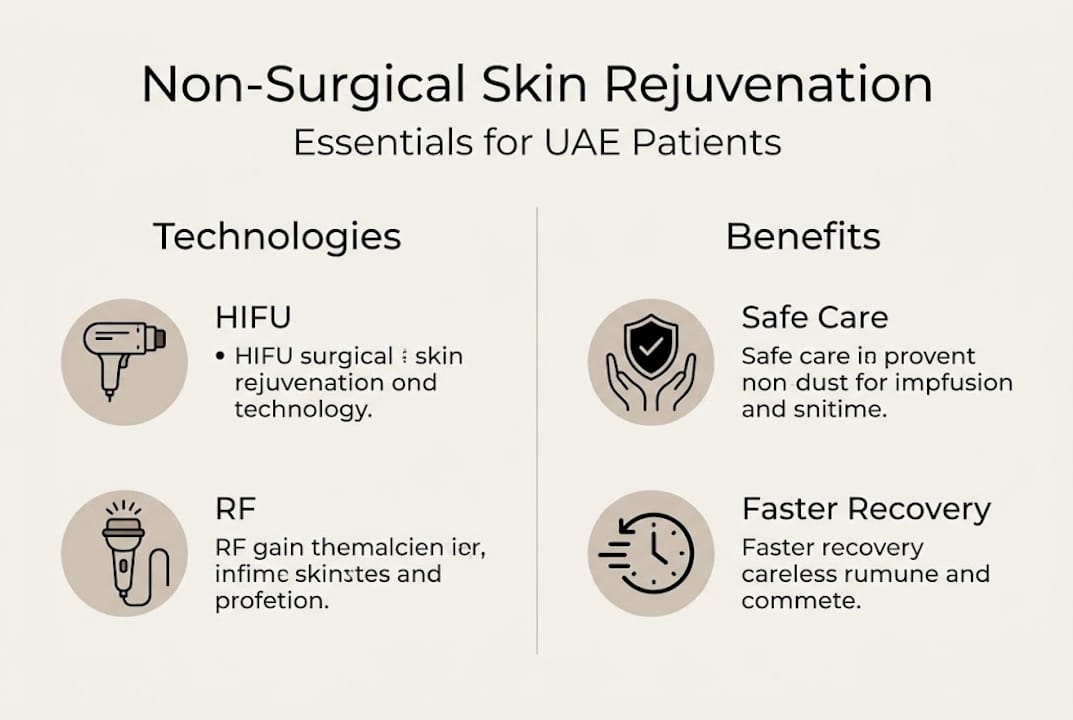
The science behind all of these comes down to one word: collagen. Non-surgical treatments stimulate collagen production, leading to skin tightening without any incisions. When thermal energy creates controlled micro-injuries in the dermis, your skin responds by producing fresh collagen fibers. Over weeks, this translates into firmer, smoother skin. HIFU targets deep layers while RF heats the dermis for collagen remodeling, meaning the two technologies actually complement each other when used together.
Here is a quick comparison of the main technologies:
| Technology | Mechanism | Typical session duration | Key result |
|---|---|---|---|
| HIFU | Focused ultrasound heat | 30-90 minutes | Lifting, deep tightening |
| Radiofrequency | Dermal heating | 20-60 minutes | Collagen remodeling |
| Laser resurfacing | Targeted light energy | 20-45 minutes | Texture, tone, pigment |
| Botox | Muscle relaxation | 10-20 minutes | Smoothing dynamic lines |
| Dermal fillers | Volume restoration | 15-30 minutes | Contouring, plumping |
Key procedures and their main benefits include:
- HIFU: Lifts brows, jawline, and neck without surgery
- RF microneedling (Morpheus8): Tightens skin and reduces scarring across all skin tones
- Laser skin rejuvenation: Targets sun damage, fine lines, and uneven tone, as explored in detail at laser skin rejuvenation UAE
- Botox and fillers: Restore youthful volume and movement control
- PRP therapy: Uses your own growth factors to accelerate skin renewal
For a full overview of what is available in Sharjah, the skin rejuvenation Sharjah service page covers the complete range of options.
Safety and regulations in the UAE: What sets non-surgical apart
Once you understand how non-surgical procedures work, it's vital to know why they're notably safer, especially in Sharjah and the UAE.
The UAE operates one of the most rigorous cosmetic treatment regulatory frameworks in the region. The Dubai Health Authority (DHA) and the Ministry of Health and Prevention (MOHAP) both set strict licensing requirements for clinics, practitioners, and the devices they use. This means that UAE's strict DHA/MOHAP regulations ensure safety with FDA-approved technology, a standard that many other markets simply do not enforce at the same level.
From a clinical standpoint, the safety advantages of non-surgical treatments are concrete. No anesthesia, scars, or major complications are required, and most treatments are reversible or adjustable. Compare that to surgical facelifts, which carry risks of nerve damage, prolonged recovery, and anesthesia complications.
| Risk factor | Surgical treatment | Non-surgical treatment |
|---|---|---|
| Anesthesia required | General or local | Topical numbing only |
| Recovery time | 2-6 weeks | Hours to 2 days |
| Scarring risk | Moderate to high | Minimal to none |
| Reversibility | Not reversible | Often reversible |
| Complication rate | Higher | Significantly lower |
"The shift toward non-surgical aesthetics in the UAE is not just a trend. It reflects a genuine improvement in technology and a patient population that is better informed about their options and rights." — Aesthetic medicine specialist, UAE
To verify that a clinic meets these standards, always check for visible DHA or MOHAP licensing before booking. The resources at cosmetic treatment safety UAE and safe effective UAE treatments give you practical checklists for evaluating any clinic.
Pro Tip: Before booking any aesthetic treatment, ask the clinic to show their DHA or MOHAP license and confirm that the specific device being used carries FDA clearance. A reputable clinic will share this information without hesitation.
For additional guidance on protecting yourself as a patient, safe aesthetic treatments UAE outlines exactly what to look for.
Results, affordability, and suitability: What patients experience
Understanding safety is just one part. Equally important are the actual outcomes, costs, and who can benefit from these procedures.
The results speak clearly. 93% improvement in skin tightening at six months has been documented in clinical studies, with results lasting up to two years. Patient satisfaction across non-surgical modalities consistently falls between 85% and 93%, which is competitive with surgical outcomes and without the associated recovery burden.
On cost, the difference is significant. Non-surgical treatments cost AED 2,500-10,000 compared to surgical procedures that can run several times higher, not counting hospital fees, anesthesia, and post-operative care. For most patients in Sharjah and the UAE, this price range makes regular maintenance genuinely accessible.
One of the most underappreciated advantages is suitability across skin types. Technologies like Morpheus8 use color-blind radiofrequency energy, meaning they work equally well on darker skin tones that can be damaged by certain laser wavelengths. Natural-looking, gradual results are safe for all skin types in the UAE's diverse population, which matters enormously in a city like Sharjah where patients represent dozens of ethnicities.
Here is what to expect at each stage of treatment:
- Before: Consultation with a licensed practitioner to assess skin type, goals, and medical history. Avoid blood thinners and sun exposure for a few days prior.
- During: Topical numbing cream is applied. The device is moved across the treatment area. Most sessions feel like warmth or mild pressure. Duration varies by technology.
- After: Mild redness or swelling is normal and typically fades within hours. Results begin to appear over four to twelve weeks as collagen builds.
- Maintenance: A follow-up session every 12 to 18 months keeps results consistent.
For a broader look at what is working for patients right now, top skin treatments UAE and aesthetic treatments skin rejuvenation are excellent starting points.
Limitations, maintenance, and expert guidance: Making the right choice
Even with impressive results, it's smart to recognize when non-surgical approaches may not be the best fit and how expert planning impacts outcomes.
Non-surgical treatments are not a universal solution. Patients with severe skin laxity, meaning significant sagging that has lost most structural support, may find that surgical intervention produces more dramatic and lasting correction. If your long-term goal involves major structural change to facial anatomy, a surgical consultation is worth having. The honest answer from any reputable clinic will include this caveat.
Common temporary side effects and how to minimize them:
- Redness and warmth: Normal after RF or laser. Apply a cool compress and avoid direct sun for 48 hours.
- Mild swelling: Expected with fillers or HIFU. Sleeping elevated the first night helps.
- Bruising: More likely with injectables. Avoid alcohol and blood thinners for several days before treatment.
- Sensitivity: Skin may feel tender for a day or two. Use gentle, fragrance-free products.
- Temporary numbness: Occasionally occurs after HIFU. Resolves within days.
Temporary side effects and the need for maintenance are real considerations, but they are manageable when you work with experienced practitioners who set realistic expectations from the start.
The UAE cosmetic market increasingly favors non-invasive options, driven by busy professional lifestyles and the influence of social media on beauty standards. Patients want results they can show in photos within days, not months after surgical recovery.
Multi-modality plans yield the best results, combining HIFU for lifting, RF for tightening, and fillers for volume in a single coordinated plan. This approach requires a practitioner who understands how the technologies interact, which is why choosing a DHA-licensed clinic with documented experience across multiple modalities matters.
Pro Tip: Ask your clinic how many different technologies they use in a single treatment plan. A practitioner who only offers one device may not be giving you the most effective protocol for your specific concerns.
For more guidance on building a smart skin care plan, cosmetic dermatology tips UAE and safe laser treatments UAE are worth reading before your first consultation.
A fresh perspective: The hidden strengths of non-surgical care in the UAE
Most global guides on non-surgical aesthetics treat the UAE as just another market. That is a mistake.
The UAE's regulatory environment is genuinely exceptional. DHA/MOHAP regulations with FDA-approved technology make the UAE a benchmark for medical tourism in aesthetics, not just a destination. Patients flying in from other Gulf countries specifically seek UAE clinics because the oversight is stricter and the accountability is real.
There is also the multicultural dimension. Sharjah's patient population spans South Asian, Arab, African, and European skin types. Clinics here develop genuine expertise in treating diverse skin tones that many single-market clinics simply never encounter. That breadth of experience translates directly into better outcomes for every patient, regardless of background.
Finally, the digital culture of the UAE accelerates quality. Patients share results publicly, compare clinics openly, and hold providers to a visible standard. That social accountability pushes clinics to perform at a higher level than markets where patient feedback stays private. At rejuvenation Sharjah, you can see how this standard shapes the treatment options available to you.
Expert non-surgical treatments in Sharjah: Next steps
If the evidence in this article has helped clarify your options, the next step is a conversation with a licensed specialist who can assess your skin and build a personalized plan.
At CosmoLaser Medical Center in Sharjah, our DHA-licensed practitioners offer the full range of non-surgical treatments, from botox treatment Sharjah and dermal fillers Sharjah to advanced laser and RF protocols. Every treatment plan follows a structured cosmetic dermatology workflow UAE designed to deliver safe, natural-looking results tailored to your skin type and goals. Book a consultation today and take the first step toward results you can actually see.
Frequently asked questions
How long do non-surgical treatments last?
Most non-surgical treatments deliver visible results for 12-24 months, and periodic maintenance sessions help sustain those results over the long term.
Are non-surgical treatments safe for all skin types in the UAE?
Yes, modern devices like Morpheus8 use color-blind technology, making them safe for all skin types across Sharjah and the UAE's diverse population.
What side effects can occur with non-surgical procedures?
Temporary redness, swelling, or mild discomfort are the most common reactions, and they typically resolve within a few hours to a couple of days.
How do costs compare between non-surgical and surgical options in Sharjah?
Non-surgical treatments generally cost AED 2,500-10,000, while surgical procedures carry significantly higher price tags when you factor in hospital fees and recovery costs.