
Lasers in skincare are far more than a tool for hair removal or a luxury reserved for celebrities. In the UAE, where sun exposure is intense year-round and skin tones range widely across Fitzpatrick types III through VI, advanced laser technology has become one of the most effective and accessible solutions for real skin concerns. We're talking about scars, stubborn pigmentation, uneven texture, and visible aging. This guide breaks down exactly how modern lasers work, which options are safest for diverse skin, and what results you can realistically expect when you choose the right treatment.
Table of Contents
- How advanced lasers work in skincare
- Types of advanced lasers used in skincare
- Real-world results: How effective are advanced lasers?
- Safety in focus: Lasers and diverse skin tones in the UAE
- Hybrid and combination therapies: Maximizing results
- Ready to see what advanced lasers can do for your skin?
- Frequently asked questions
Key Takeaways
| Point | Details |
|---|---|
| Lasers target precise skin concerns | Advanced lasers use science-backed mechanisms to treat scars, pigmentation, and aging without damaging healthy skin. |
| Safety depends on skin type | Non-ablative and fractional lasers are safest for medium to darker skin tones prevalent in the UAE. |
| Results are clinically proven | Most people see 70-90% scar reduction in 1-3 sessions or significant textural improvements. |
| Combination treatments boost outcomes | Hybrid laser protocols can maximize results, especially for complex cases like severe scars or pigmentation. |
| Proper aftercare ensures success | Effective post-treatment steps like sun avoidance and regenerative topicals speed up healing and enhance your results. |
How advanced lasers work in skincare
Lasers in skincare use specific wavelengths of light to target what scientists call chromophores. These are color-conveying molecules inside your skin, specifically water, melanin (the pigment that gives skin its color), and hemoglobin (the protein in blood). Each laser wavelength is tuned to interact with one of these targets, which is why different lasers treat different problems.
There are three core mechanisms at work:
- Photothermal: The laser heats tissue to stimulate collagen remodeling. This is the basis for most anti-aging and resurfacing treatments.
- Photochemical: Used in photodynamic therapy, this approach activates a light-sensitive compound to treat conditions like acne or sun damage.
- Photomechanical: Ultra-short pulses create pressure waves that shatter pigment or tattoo ink without burning surrounding tissue.
The principle that makes all of this precise is called selective photothermolysis. It means the laser targets only the problem area, leaving healthy surrounding skin untouched. As how laser technology works explains, some devices also create micro-cavities beneath the skin surface, triggering regeneration without visible surface damage.
"Advanced lasers target water, melanin, and hemoglobin using mechanisms such as selective photothermolysis and photomechanical effects."
For UAE residents dealing with post-acne scarring, sun-induced pigmentation, or early signs of aging, understanding these mechanisms helps you ask the right questions before committing to a treatment plan.
Types of advanced lasers used in skincare
Not all lasers are the same, and choosing the wrong one for your skin type or concern can lead to poor results or complications. Here is a clear breakdown of the three main categories.
| Laser type | Mechanism | Downtime | Best for | Typical result |
|---|---|---|---|---|
| Ablative (CO2, Er:YAG) | Removes outer skin layers | 5-10 days | Deep scars, wrinkles | High impact, dramatic resurfacing |
| Non-ablative (Nd:YAG, Diode) | Heats dermis, surface intact | 0-2 days | Mild rejuvenation, pigment | Gradual, gentle improvement |
| Fractional (ablative or non-ablative) | Micro-columns of treatment | 2-5 days | Scars, texture, tone | Strong results, faster recovery |
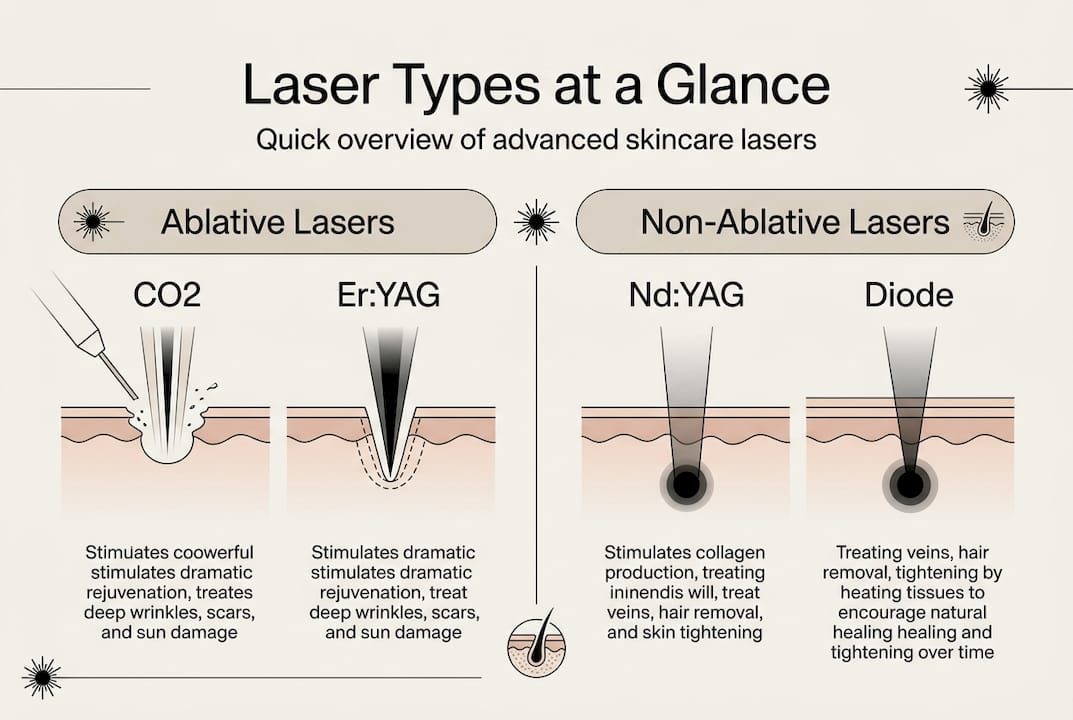
As clinical evidence on fractional versus traditional lasers confirms, ablative lasers vaporize tissue for resurfacing, non-ablative lasers heat the dermis without harming the surface, and fractional lasers limit downtime by treating only a fraction of the skin at a time.
Key differences to keep in mind:
- Ablative lasers deliver the most dramatic results but require the most recovery time and carry higher risk for darker skin tones.
- Non-ablative lasers are gentler and work well for maintenance or mild concerns.
- Fractional lasers split the difference, offering strong outcomes with a more manageable recovery window.
Pro Tip: In the UAE's sun-heavy climate, fractional CO2 variants offer results comparable to fully ablative treatments but with significantly less risk of sun-triggered complications during recovery. Always schedule treatments during cooler months or plan strict indoor recovery.
For a deeper look at fractional laser safety and what to expect, it's worth reviewing the clinical guidance before your consultation.
Real-world results: How effective are advanced lasers?
Numbers matter when you're deciding whether a treatment is worth your time and investment. Clinical data on advanced lasers is strong, and the results speak clearly.
Across multiple modalities and indications including scars, pigmentation, and general rejuvenation, benchmarks show 18% of patients achieve excellent responses, 31% achieve good responses, and 40% see fair improvement. That means nearly 70% see good to excellent results after modern laser sessions, a figure that holds across diverse patient populations.
For specific concerns:
| Laser type | Indication | Response rate | Sessions needed |
|---|---|---|---|
| Fractional CO2 | Acne scars | 70-90% improvement | 1-3 sessions |
| Er:YAG | Superficial scars, rejuvenation | Highest excellent rate | 2-4 sessions |
| Nd:YAG | Pigmentation, skin tone | Good to excellent | 3-5 sessions |
Fractional CO2 stands out for scar treatment, with 70-90% scar reduction achievable in just one to three sessions, with typical downtime of five to seven days. Er:YAG is particularly effective for lighter scars and is considered safer for a broader range of skin tones.
For those pursuing laser skin rejuvenation, these numbers provide a realistic baseline. Results vary based on skin type, severity of the concern, and the expertise of the treating specialist, but the data is genuinely encouraging.
Safety in focus: Lasers and diverse skin tones in the UAE
Effectiveness means nothing if the treatment causes new problems. In the UAE, where a large portion of the population has Fitzpatrick skin types III through VI, safety is a non-negotiable part of any laser conversation.
The primary risk for darker skin tones is post-inflammatory hyperpigmentation, or PIH. This is a darkening of the skin that occurs as a response to inflammation or injury. Ablative lasers pose a higher PIH risk and microbiome disruption, especially in skin of color, while fractional and non-ablative methods are significantly safer.
Who should approach laser treatments with extra caution:
- Individuals with Fitzpatrick types V and VI considering ablative CO2 treatments
- Anyone with active keloid scarring or a history of abnormal wound healing
- Patients who cannot commit to strict sun avoidance during recovery
- Those currently using photosensitizing medications
For safer outcomes, prefer low-fluence Nd:YAG or Er:YAG for darker tones, always pre-treat with topical brighteners, and use strict sunscreen before and after treatment.
"The right laser for your skin tone is not the most powerful one. It's the one calibrated precisely for your chromophore profile and recovery capacity."
Pro Tip: Always request a patch test at least two weeks before your full treatment. This small step can reveal how your skin responds and allows your specialist to adjust settings before treating a larger area.
For guidance on safe lasers for darker skin, reviewing evidence-based protocols is the smartest first step.
Hybrid and combination therapies: Maximizing results
Single-laser treatments are effective, but for complex concerns like deep acne scars combined with uneven pigmentation, combining technologies often delivers superior outcomes. The logic is straightforward: different lasers reach different skin layers, so using more than one addresses the full depth of the problem.
A typical hybrid protocol for scar treatment looks like this:
- Initial consultation: Skin assessment, Fitzpatrick typing, and photography to document baseline.
- Test spot: A small area is treated to evaluate your skin's response before full treatment.
- Dual sessions: Fractional CO2 targets surface texture and scar depth, while long-pulsed Nd:YAG stimulates deep collagen remodeling.
- Aftercare: Regenerative topicals, strict sun protection, and follow-up assessments at two and four weeks.
A study of 88 patients using combined fractional CO2 plus Nd:YAG showed significant improvements in both ECCA (Echelle d'Evaluation Clinique des Cicatrices d'Acne, a clinical scar grading scale) and VSS (Vancouver Scar Scale) scores, outperforming single-laser approaches.
Benefits of combination treatments include:
- Fewer total sessions needed compared to single-modality approaches
- More dramatic improvements for complex or layered scar types
- Ability to address both surface texture and deep structural changes simultaneously
- Reduced overall recovery time when sessions are strategically spaced
For those considering advanced skin resurfacing, a combination approach may be the most efficient path to visible, lasting results. Pairing your treatment with the right post-laser recovery tips is equally important for protecting your investment and accelerating healing.
Ready to see what advanced lasers can do for your skin?
At CosmoLaser Medical Center in Sharjah, our specialists work with the full spectrum of advanced laser technologies, from fractional CO2 to long-pulsed Nd:YAG, tailored specifically to your skin tone, concerns, and lifestyle. We understand the unique challenges of UAE skin, including sun exposure, diverse Fitzpatrick types, and the need for minimal downtime.
Whether you're targeting acne scars, pigmentation, or overall skin rejuvenation, we build personalized treatment plans backed by clinical evidence. Book your consultation today and let our team design a laser protocol that delivers real, measurable results safely and effectively. Visit cosmolaser.me to get started.
Frequently asked questions
Are advanced laser treatments painful or require anesthesia?
Most advanced lasers use cooling devices or topical anesthetics, so discomfort is minimal and brief. Modern fractional and non-ablative lasers are specifically designed for improved patient comfort.
How many laser sessions will I typically need for skin rejuvenation?
Most patients see strong results in one to three sessions for scars or texture concerns. Fractional CO2 reduces scars by 70-90% in that range, though pigmentation may require additional sessions depending on severity.
Is laser treatment safe for darker skin tones in the UAE?
Yes, particularly with non-ablative or fractional lasers combined with proper pre-care and post-care. PIH rates in skin of color range from 0.73% to 8.1% with fractional methods, making them a much safer choice than ablative alternatives.
What aftercare is essential following advanced laser treatments?
Gentle cleansing, strict daily sun protection, and regenerative topicals are the three pillars of post-laser care. Following evidence-based recovery protocols helps preserve results and speeds healing significantly.
Can lasers help with both scars and pigment concerns?
Yes, and combined protocols are often the most effective approach. Combined fractional CO2 plus Nd:YAG therapies address both concerns simultaneously, but treatment must be personalized based on your skin type and the severity of each issue.