
Fractional laser treatment stands out as a precise, controlled method for addressing common skin concerns without the extended recovery times of older laser technologies. By targeting microscopic zones of tissue while leaving surrounding skin intact, this approach triggers natural healing processes that visibly improve texture, tone, and overall appearance. Whether you're dealing with acne scars, sun damage, or signs of aging, understanding how fractional lasers work and what makes them safer than traditional methods empowers you to make informed decisions about your skin health. This guide walks you through the science, applications, safety considerations, and what to expect from treatment.
Table of Contents
- Key takeaways
- Understanding fractional laser technology: how it works and types
- What can fractional laser treat? Common skin concerns and expected results
- Safety considerations and suitability: what you should know before treatment
- Combining fractional laser treatment with advanced therapies for enhanced results
- Explore fractional laser treatment options at Cosmolaser Medical Center
- Frequently asked questions about fractional laser treatment
Key Takeaways
| Point | Details |
|---|---|
| MTZ based healing | Fractional lasers deliver energy in tiny zones surrounded by untreated skin, triggering controlled wound healing and collagen remodeling. |
| Ablative vs non ablative | Ablative lasers vaporize tissue and reach deeper layers with longer downtime, while non ablative lasers heat tissue without removing the epidermis and require multiple sessions. |
| Multiple sessions needed | Clinical results improve across three to five sessions, with maximum effects appearing months after the final treatment. |
| Safe for darker skin | Careful parameter tuning and device selection reduce risks and uneven results, especially for darker skin tones. |
Understanding fractional laser technology: how it works and types
Fractional laser treatment delivers energy in microscopic zones surrounded by untreated skin, promoting faster healing. This technique, called fractional photothermolysis, creates thousands of microscopic thermal zones (MTZs) across the treatment area. Each MTZ measures just 50-500 micrometers in diameter, triggering controlled wound healing while preserving healthy tissue bridges between zones.
These untreated areas serve as reservoirs of healthy cells that rapidly migrate into treated zones, accelerating recovery. The body responds by ramping up collagen production and remodeling damaged tissue from the inside out. Within days, new skin cells resurface while deeper layers continue rebuilding for months.
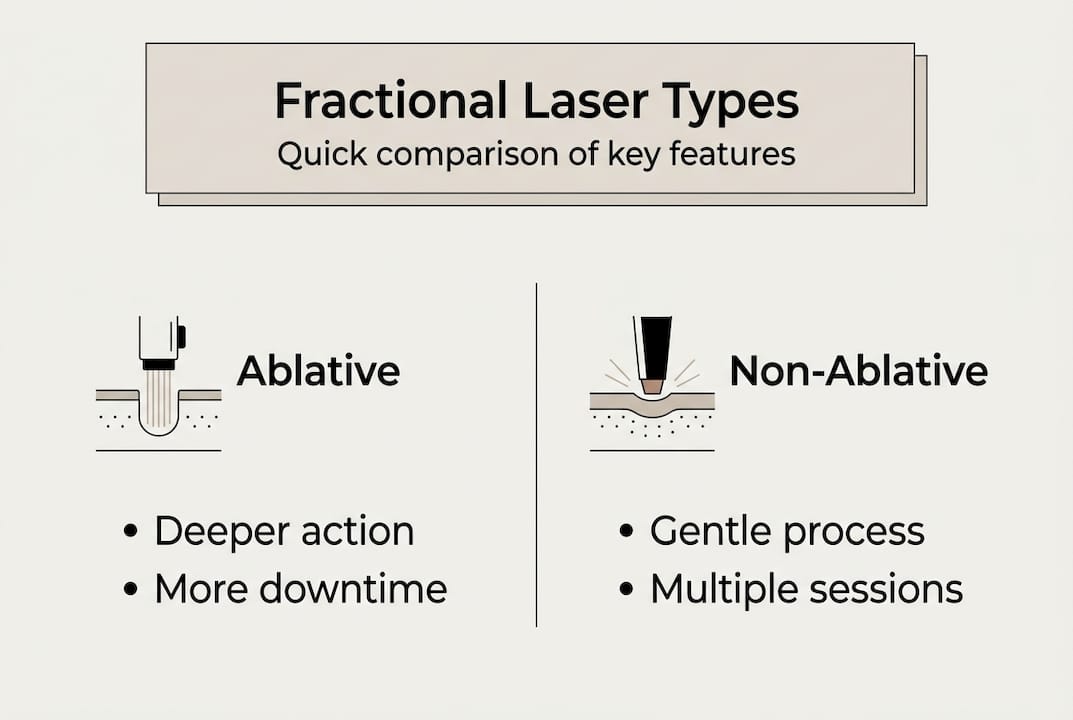
Two main categories define fractional laser systems. Ablative lasers vaporize tissue and penetrate 2-4 mm deep, removing the epidermis to reach deeper dermal layers. CO2 lasers (10,600 nm wavelength) exemplify this category, delivering dramatic results for severe scarring and deep wrinkles. The tradeoff involves 7-14 days of downtime with visible peeling and redness.
Non-ablative lasers heat tissue without removing epidermis, requiring multiple sessions but safer for darker skin. Erbium glass lasers (1550 nm) and similar devices work beneath the surface, stimulating collagen without creating open wounds. Recovery typically spans 2-4 days with mild redness.
| Laser Type | Wavelength | Penetration Depth | Downtime | Best For |
|---|---|---|---|---|
| Ablative CO2 | 10,600 nm | 2-4 mm | 7-14 days | Deep scars, severe wrinkles, significant sun damage |
| Non-ablative Er:Glass | 1550 nm | 0.5-1.5 mm | 2-4 days | Mild to moderate concerns, darker skin tones, maintenance |
Pro Tip: Fractional technology's key advantage over full-field lasers lies in those untreated tissue bridges. Traditional lasers treated entire surfaces at once, requiring weeks of recovery. By leaving healthy skin intact between treatment zones, fractional systems cut healing time by 60-70% while delivering comparable long-term results. For more context on various laser skin resurfacing UAE guide approaches, explore comprehensive overviews of available skin resurfacing options.
What can fractional laser treat? Common skin concerns and expected results
Fractional lasers address multiple skin conditions through controlled tissue remodeling. The technology proves particularly effective for:
- Acne scars, including boxcar, rolling, and ice pick varieties
- Hyperpigmentation from sun exposure, melasma, or post-inflammatory changes
- Fine lines and moderate wrinkles around eyes, mouth, and forehead
- Sun damage manifesting as rough texture, uneven tone, and age spots
- Stretch marks on abdomen, thighs, and other body areas
- Enlarged pores and overall texture irregularities
The treatment works by initiating three overlapping phases of wound healing. First, the inflammatory phase (days 1-3) clears damaged tissue and activates growth factors. Next, the proliferative phase (days 4-21) generates new collagen fibers and blood vessels. Finally, the remodeling phase (months 1-6) reorganizes collagen into stronger, more organized networks.

Fractional laser treatment yields 40-60% scar reduction and notable pigment and wrinkle improvements over multiple sessions. Clinical trials tracking patients through 3-5 treatments demonstrate progressive enhancement, with maximum results appearing 3-6 months after the final session.
Quantitative research reveals impressive specifics. Studies show 93% pigmentation improvement and up to 79% wrinkle reduction within a month post-treatment. These measurements used standardized assessment scales and digital imaging analysis, providing objective evidence of efficacy.
Key Statistics: Patients with moderate acne scarring achieved 51% average improvement after four sessions. Pigmentation disorders responded with 93% clearance rates. Wrinkle depth decreased by 79% in periorbital areas, with sustained improvement at six-month follow-up.
The epidermis completely regenerates within 7-10 days post-treatment, while dermal remodeling continues for months. New collagen deposits increase skin thickness by 15-30%, creating a firmer foundation that reduces future wrinkle formation. This dual action of surface renewal and deep structural improvement explains why results continue improving long after visible healing completes. Compare these outcomes with chemical peels for acne scars or explore broader skin rejuvenation treatments available.
Safety considerations and suitability: what you should know before treatment
Understanding contraindications and risk factors helps you determine if fractional laser treatment suits your situation. Certain conditions require postponing or avoiding treatment:
- Active skin infections including herpes simplex, bacterial folliculitis, or fungal conditions
- Current isotretinoin (Accutane) use or completion within the past 6-12 months
- Keloid scarring tendency or abnormal wound healing history
- Pregnancy or active breastfeeding
- Recent chemical peels or other aggressive treatments within 2-4 weeks
- Unrealistic expectations about results or unwillingness to follow aftercare protocols
Skin tone significantly impacts treatment planning. Non-ablative lasers are safer for darker skin due to lower hyperpigmentation risk; ablative require caution. Fitzpatrick skin types IV-VI contain higher melanin concentrations that absorb laser energy, potentially causing post-inflammatory hyperpigmentation if parameters aren't carefully adjusted.
Clinicians address this by reducing fluence (energy density), lengthening pulse duration, and increasing intervals between sessions. These modifications allow melanin to dissipate heat safely while still triggering therapeutic collagen response. Pre-treatment with topical agents like hydroquinone or tretinoin further stabilizes melanocytes.
Session limits matter for safety and effectiveness. Research indicates limiting treatment to six sessions for certain scar types prevents excessive tissue trauma and diminishing returns. Overdoing treatments can trigger chronic inflammation, paradoxically worsening texture or causing permanent pigment changes.
Pro Tip: Choose a clinic that customizes fluence, density, and pulse width based on your specific skin type and concern. Cookie-cutter settings applied to every patient increase complication risks. Experienced practitioners perform test spots on inconspicuous areas, then adjust parameters based on your skin's individual response before treating larger zones.
Monitoring controlled inflammation and temperature increases post-laser is key for safe skin regeneration. The ideal thermal injury stimulates healing without causing excessive damage. Practitioners achieve this balance by tracking skin temperature during treatment and applying appropriate cooling methods immediately after.
Post-treatment care directly influences outcomes and safety. Strict sun avoidance for 4-6 weeks prevents pigmentation issues. Gentle cleansing with non-irritating products supports healing without disrupting new tissue formation. Prescribed topical medications accelerate recovery while minimizing infection risk. Learn more about complementary approaches like PRP therapy details or dive into laser technology safety insights.
Combining fractional laser treatment with advanced therapies for enhanced results
Integrating regenerative therapies with fractional laser sessions amplifies outcomes beyond what either treatment achieves alone. Combining fractional laser with PRP or exosomes enhances collagen remodeling and healing, improving outcomes over standalone laser therapy.
Platelet-rich plasma (PRP) contains concentrated growth factors that accelerate tissue repair. When applied immediately after fractional laser treatment, these bioactive proteins penetrate through the microscopic channels created by the laser, reaching deeper dermal layers. The growth factors stimulate fibroblast activity, increasing collagen and elastin production by 30-40% compared to laser alone.
Exosomes represent the next evolution in regenerative aesthetics. These tiny vesicles derived from stem cells carry messenger RNA, microRNA, and signaling proteins that direct cellular behavior. Applied post-laser, exosomes guide skin cells toward optimal healing patterns, reducing inflammation while maximizing collagen organization.
A typical combination protocol follows this sequence:
- Pre-treatment assessment and photography to establish baseline
- Topical anesthetic application for 30-45 minutes to ensure comfort
- Fractional laser treatment performed with customized parameters for your skin type
- Immediate application of PRP or exosome solution across treated areas
- Cooling mask or cold air device to reduce thermal sensation
- Post-treatment instructions including specific skincare products and sun protection
- Follow-up sessions scheduled 4-6 weeks apart for optimal cumulative benefit
- Final assessment at 3-6 months to document full results
Patients receiving combination therapy report faster resolution of redness and swelling. Clinical measurements show 25% greater improvement in skin texture scores and 20% better pigmentation clearance compared to laser-only groups. The enhanced collagen quality also translates to longer-lasting results.
Emerging protocols explore triple combinations. Some clinics now sequence fractional laser, followed by PRP application, then microneedling 2-3 weeks later to further drive growth factors into tissue. Early results suggest this approach may shorten total treatment time while maximizing improvement.
Future trends point toward personalized regenerative cocktails tailored to individual healing profiles. Genetic testing may soon guide selection of specific growth factors, cytokines, and stem cell derivatives that match your unique cellular response patterns. This precision approach promises to eliminate trial and error, delivering optimal results from the first session. Explore comprehensive skin rejuvenation treatments or learn specific details about PRP therapy information.
Explore fractional laser treatment options at Cosmolaser Medical Center
Ready to experience the transformative benefits of fractional laser technology? Cosmolaser Medical Center in Sharjah offers both ablative and non-ablative fractional laser systems operated by experienced aesthetic specialists. Our practitioners customize treatment parameters for your unique skin type and concerns, ensuring safe, effective results.
We integrate fractional laser sessions with complementary therapies like PRP to accelerate healing and enhance outcomes. Our comprehensive approach addresses not just surface concerns but underlying skin health for lasting improvement. Why choose Cosmolaser for your fractional laser treatment?
- Board-certified practitioners with specialized training in laser dermatology
- Latest FDA-approved fractional laser technology for precise, controlled treatment
- Customized protocols based on thorough skin analysis and your specific goals
- Complementary regenerative therapies including PRP and advanced skincare
- Transparent pricing and flexible treatment plans
Book a consultation to discuss your skin concerns and receive a personalized treatment plan. Our team will assess your skin type, explain expected outcomes, and design a protocol that fits your schedule and budget. Discover our full range of skin resurfacing services, explore various skin rejuvenation treatments, or learn about PRP therapy options available at our Sharjah location.
Frequently asked questions about fractional laser treatment
What is the difference between ablative and non-ablative fractional lasers?
Ablative fractional lasers remove the epidermis and penetrate 2-4 mm deep into the dermis, vaporizing tissue to trigger intensive collagen remodeling. Non-ablative lasers heat dermal tissue without removing surface skin, working beneath the epidermis with less downtime. Ablative delivers more dramatic results in fewer sessions but requires 7-14 days recovery, while non-ablative needs multiple treatments with only 2-4 days downtime.
How many sessions will I need for noticeable skin improvement?
Most patients require 3-5 sessions spaced 4-6 weeks apart for optimal results. Mild concerns like early sun damage may respond to 2-3 treatments, while deeper acne scars or significant wrinkles often need 4-6 sessions. Results continue improving for 3-6 months after your final treatment as collagen remodeling progresses. Your practitioner will recommend a specific protocol based on your skin assessment.
Is fractional laser treatment safe for darker skin tones common in the UAE?
Yes, when proper protocols are followed. Non-ablative fractional lasers present lower hyperpigmentation risk for Fitzpatrick skin types IV-VI compared to ablative systems. Practitioners reduce energy density, extend pulse duration, and may prescribe pre-treatment topical agents to stabilize melanin. Test spots on inconspicuous areas help determine safe parameters before treating visible zones. Choose experienced providers familiar with treating diverse skin tones.
What should I expect during recovery and downtime?
Non-ablative treatments cause 2-4 days of mild redness and slight swelling, similar to a sunburn. Ablative procedures involve 7-14 days with visible peeling, crusting, and more pronounced redness. All fractional treatments require strict sun avoidance for 4-6 weeks and gentle skincare products. Most patients return to work within 3-5 days for non-ablative and 10-14 days for ablative treatments. Makeup can typically cover residual redness.
Can fractional laser treat pigmentation and acne scars effectively?
Fractional lasers achieve 40-60% scar improvement and up to 93% pigmentation clearance over multiple sessions according to clinical studies. The technology breaks up scar tissue and abnormal pigment deposits while stimulating organized collagen formation. Acne scars respond particularly well, with boxcar and rolling types showing greater improvement than deep ice pick scars. Pigmentation from sun damage, melasma, and post-inflammatory changes all respond favorably when treatment parameters match your skin type.