
TL;DR:
- Safety in UAE aesthetic procedures is strictly regulated, requiring licensed clinics and qualified practitioners.
- Ignoring safety standards increases risks of severe complications and costly corrective treatments.
- Choosing ethical, licensed providers who prioritize screening and emergency protocols ensures safer outcomes.
Aesthetic medicine has grown dramatically across the UAE, and with that growth comes a critical warning: not every clinic offering cosmetic treatments is operating at the same standard. Many people assume that because a procedure is labeled "non-surgical" or "quick," it carries minimal risk. That assumption can be devastating. Unlicensed procedures lead to severe complications including infections, abscesses, burns, nerve injury, and tissue necrosis, often requiring corrective surgery that costs far more than the original treatment. This guide explains what safety truly means in the UAE aesthetic space, what the regulations require, where shortcuts cause real harm, and how to protect yourself every step of the way.
Table of Contents
- What makes a procedure safe? Regulatory standards in the UAE
- Risks of neglecting safety: The real costs of shortcuts
- Complication rates: What do the numbers really say?
- How top clinics put safety first: Your role in secure outcomes
- Why safety is non-negotiable: An expert's take
- Trust your safety to expert providers
- Frequently asked questions
Key Takeaways
| Point | Details |
|---|---|
| Licensed providers required | Always choose clinics and professionals certified by DHA or MoHAP for safer outcomes. |
| Shortcuts increase risks | Unlicensed or unsafe procedures raise complication rates and often cost more to fix. |
| Understand complication rates | Surgical and combined procedures carry higher risks, but these can be managed with proper care. |
| Active patient role matters | Ask questions, disclose your medical history, and attend all required consultations for your safety. |
What makes a procedure safe? Regulatory standards in the UAE
To understand what keeps you safe, let's first look at what official regulations actually require.
Safety in aesthetic procedures is not just a matter of using good products or having a clean clinic. In the UAE, it is a formal, legally enforced framework. The Dubai Health Authority (DHA) and the Ministry of Health and Prevention (MoHAP) both regulate aesthetic medicine, and their standards for non-surgical cosmetic procedures are specific and demanding. These standards require licensed facilities, qualified healthcare professionals with verified training and clinical privileges, approved equipment, and strict protocols for conducting non-surgical cosmetic work.
What does that mean in practice? Here is what a properly regulated clinic must have:
- A valid license from DHA or MoHAP, displayed and verifiable
- Physicians and practitioners with documented training specific to the procedures they perform
- Medical-grade equipment that has been approved for use in the UAE
- Mandatory face-to-face consultations before any procedure begins
- Documented patient screening, including medical history and contraindication checks
- Emergency protocols and resuscitation equipment on site
These requirements exist because cosmetic procedures, even minor ones like chemical peels or filler injections, carry genuine medical risks. A practitioner without proper training may not recognize when a patient's skin condition or medical background makes a treatment dangerous. A clinic without emergency protocols may not be able to respond if something goes wrong mid-procedure.
When you explore safe aesthetic treatments in the UAE, you will see that the difference between a safe outcome and a serious complication often comes down to whether these steps were followed. Using a treatment safety checklist before booking any procedure is one of the smartest things you can do.
Pro Tip: Before booking any aesthetic procedure, ask the clinic to show you their DHA or MoHAP license number. You can verify it directly on the authority's official website. If a clinic hesitates or cannot produce documentation, walk away.
The real consequences of ignoring these standards go beyond physical harm. Courts in the UAE have held licensed surgeons liable for negligence in elective procedures. If something goes wrong in an unlicensed setting, legal recourse is far more complicated, and the burden of proof falls entirely on you.
Risks of neglecting safety: The real costs of shortcuts
Now that you know what's required for safety, it's important to recognize the risks if these protocols are ignored.
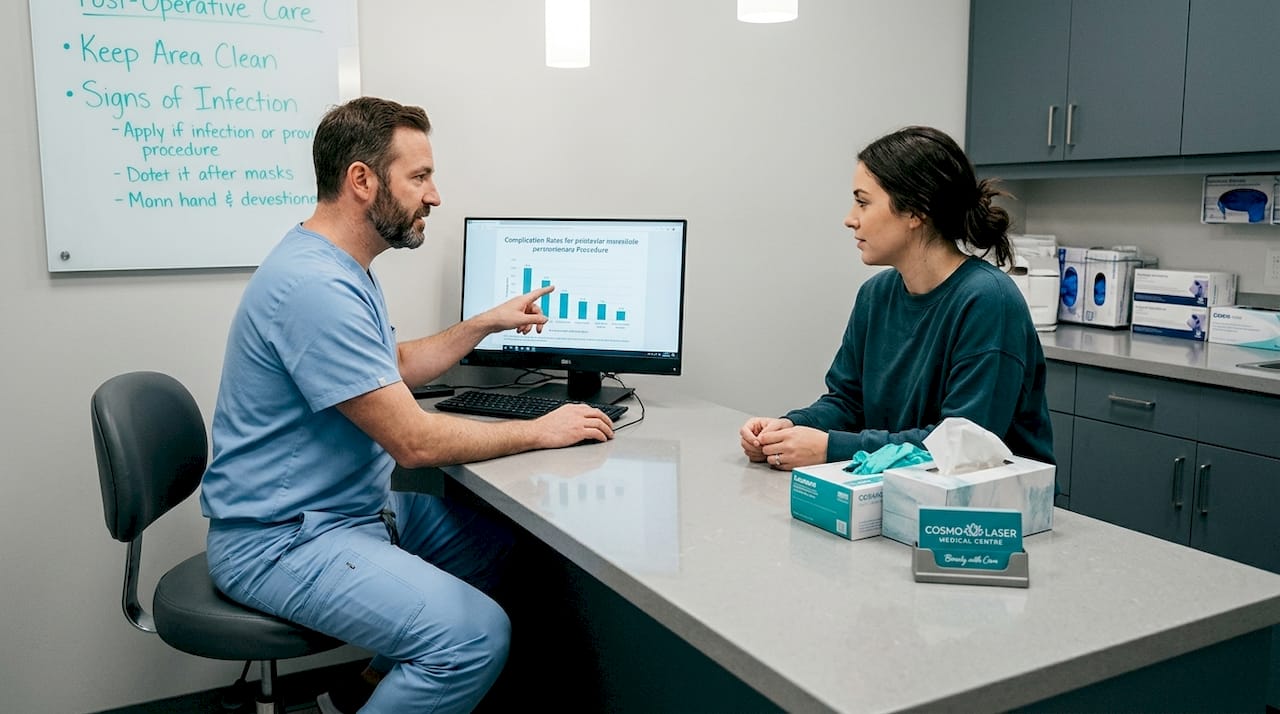
The gap between a licensed clinic and an unlicensed one is not just administrative. It is the difference between a controlled medical environment and a space where anything can happen. UAE doctors have treated cases of permanent damage from illegal clinics, while properly licensed facilities maintain resuscitation equipment and established emergency protocols that can make the difference between a recoverable situation and a permanent injury.
Here is how shortcuts put you at risk, in order of how they typically unfold:
- No proper screening. Unlicensed providers skip medical history checks, meaning they may inject fillers into a patient on blood thinners, use lasers on a skin type prone to burns, or proceed with a treatment that is completely contraindicated.
- Unregulated products. Many unlicensed providers source products from unverified suppliers. Counterfeit or unregistered injectables can contain harmful substances that cause reactions no treatment can easily reverse.
- No emergency preparedness. If something goes wrong, an unlicensed provider has no protocol and likely no equipment to stabilize you. Licensed facilities are required to have resuscitation tools and trained staff on hand.
The physical complications that arise from unsafe practices are serious. These include bacterial infections that spread rapidly, abscesses that require surgical drainage, chemical burns from poorly applied peels, and nerve damage from improperly placed injections. In severe cases, tissue necrosis (where skin and underlying tissue begin to die) can develop, especially from vascular occlusion caused by filler injections in the wrong hands.
| Complication type | Common cause | Potential outcome |
|---|---|---|
| Infection / abscess | Unsterile environment | Hospitalization, scarring |
| Burns | Incorrect laser settings | Permanent discoloration |
| Nerve damage | Improper injection placement | Facial asymmetry, numbness |
| Tissue necrosis | Vascular occlusion from fillers | Surgical debridement, disfigurement |
| Allergic reaction | Unverified product ingredients | Systemic reaction, anaphylaxis |
"Doctors in the UAE have treated patients with permanent damage resulting from procedures performed in illegal or unlicensed settings. Licensed facilities, by contrast, are required to maintain resuscitation equipment and documented emergency response protocols." — UAE medical professionals, as reported by MENAFN
The financial cost of corrective care is staggering. Treating a severe infection or reversing botched filler work can cost several times more than the original discounted procedure. When you look at guidance on selecting a cosmetic clinic or safe booking for procedures, the recurring theme is always verification first. Saving money upfront is never worth the physical and financial burden of complications.
Complication rates: What do the numbers really say?
Understanding the risks in detail can help you interpret numbers you may hear from clinics. Let's break them down.
One of the most important things to understand is that complication rates are not uniform across procedures. Surgical procedures carry higher risks than non-surgical ones, and the risk increases significantly when multiple procedures are combined in a single session.
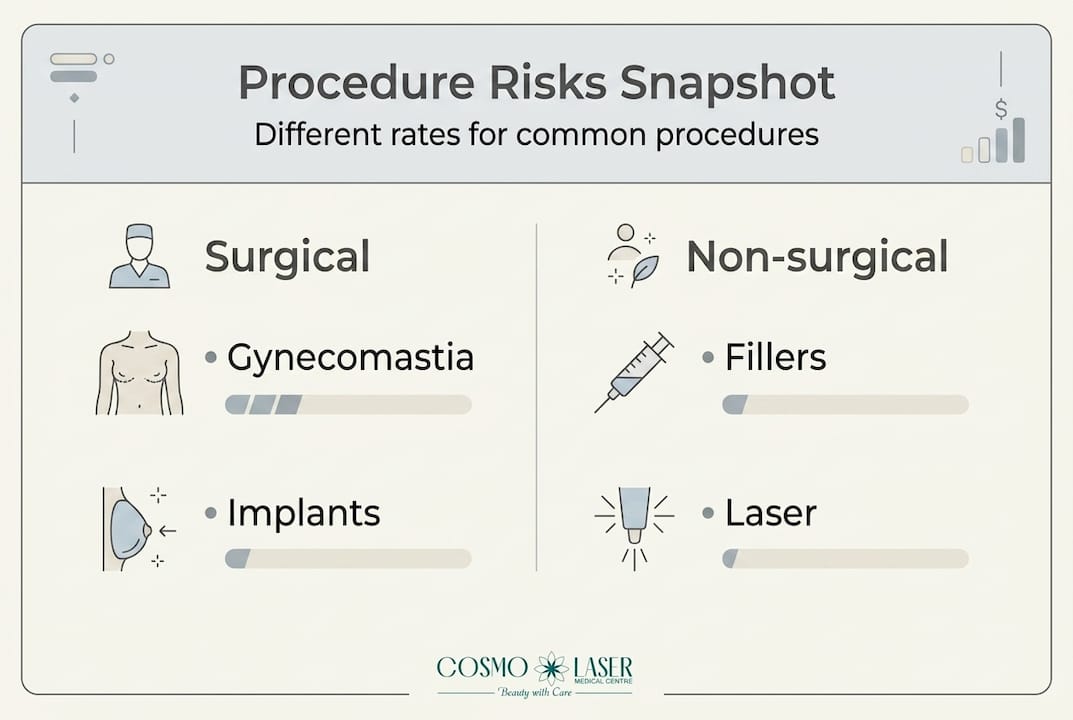
In gynecomastia surgery (a common aesthetic surgery among men), the complication rate reaches 16.16%, including haematoma formation at 3.03%, seroma at 1.01%, and recurrence at 8.59%. These are not alarming numbers when placed in context, but they do illustrate that even straightforward aesthetic surgeries carry real risks.
Implant-based procedures show even higher complication rates. In breast reconstruction studies, infection rates reached 31.81%, skin necrosis occurred in 27.27% of cases, and seroma developed in 18.18%. Roughly 16.4% of patients required implant removal. Notably, patients using tissue expanders had an 80% complication rate compared to 26.86% for fixed-volume implants. This is the kind of data that underscores why the choice of technique, not just the surgeon, matters enormously.
| Procedure type | Complication rate | Key risks |
|---|---|---|
| Gynecomastia surgery | 16.16% | Haematoma, seroma, recurrence |
| Implant-based reconstruction | Up to 80% (tissue expanders) | Infection, skin necrosis, seroma |
| Single aesthetic procedure | 26.3% | Varies by procedure |
| Combined aesthetic surgeries | 49.1% | Compound risks across sites |
That last figure is particularly striking. Combined aesthetic surgeries carry a complication rate of 49.1%, compared to 26.3% for single procedures. This applies to common combinations like abdominoplasty with liposuction or breast surgery paired with another procedure. The body simply undergoes more stress, anesthesia time increases, and recovery becomes more complex.
Common complications to watch for across both surgical and non-surgical procedures include:
- Prolonged swelling or bruising beyond the normal recovery period
- Signs of infection such as redness, warmth, discharge, or fever
- Asymmetry or unnatural appearance shortly after healing
- Persistent numbness or tingling in the treated area
- Hardening or lumping beneath the skin
Understanding these numbers helps you have more informed conversations with your provider. The goal of exploring medical aesthetics safety or researching minimally invasive procedures is to go in with realistic expectations and the right questions ready.
How top clinics put safety first: Your role in secure outcomes
Knowing what can go wrong, here's how reputable clinics prevent issues, and how you can take charge, too.
The best clinics do not just follow regulations. They build safety into every layer of their workflow. This starts before you ever receive a treatment. Reputable providers require at minimum two face-to-face consultations, complete a full medical history, obtain signed informed consent, and make absolutely no false promises about outcomes. UAE courts actively hold surgeons liable for negligence in elective procedures, which means ethical clinics protect themselves by protecting you.
A critical and often overlooked safety measure is the screening for modifiable risk factors. Surgeons are expected to decline high-risk procedures when the risks clearly outweigh the benefits. Smoking significantly impairs wound healing and increases infection rates. A body mass index above 25 raises surgical risks across multiple dimensions. These are factors a qualified provider will ask about and act on, even if that means recommending you delay a procedure.
Another layer of this is psychological screening. Body dysmorphic disorder (BDD) affects approximately 18.6% of cosmetic procedure candidates. Patients with undiagnosed BDD often seek procedures to address perceived flaws that others cannot see, and surgery rarely satisfies them. Ethical providers screen for this and refer patients for appropriate mental health support rather than proceeding with treatments unlikely to help.
Here is a practical step-by-step guide for preparing for your consultation:
- Write down your full medical history, including all medications, supplements, allergies, previous surgeries, and chronic conditions.
- List your goals clearly, including what you hope to achieve and any concerns about specific outcomes.
- Prepare questions about the provider's qualifications, including how many times they have performed this specific procedure and what their complication management process looks like.
- Ask explicitly about risks, and pay attention to how the provider responds. Honest, detailed answers are a positive sign.
- Do not commit on the day of your first consultation. A provider who pressures you to book immediately should raise a red flag.
Pro Tip: Good clinic workflows include a clear process for splitting complex cases across multiple sessions. If a clinic is eager to do everything in one sitting without explaining why that is safe, ask them to justify the decision in writing. Reputable providers who prioritize choosing safe clinics will welcome that kind of scrutiny.
Why safety is non-negotiable: An expert's take
Here is the honest truth about the aesthetic industry in the UAE that most people do not want to hear. The biggest risk factor in cosmetic procedures is not the procedure itself. It is the provider selection process. And the most dangerous decision most patients make is choosing a clinic based on price.
Bargain pricing in aesthetics almost always signals one of three things: unqualified staff, unverified products, or skipped protocols. None of these are acceptable trade-offs when the consequences can include permanent scarring, facial nerve damage, or systemic infection. We have seen the aftermath of what happens when patients choose unlicensed providers or opt for high-risk procedure combinations without proper screening. The pattern is consistent: the savings feel real until they are not.
The most telling sign of a truly ethical clinic is not the equipment or the décor. It is whether your provider ever tells you "no." A provider who agrees to every request, promises perfect results, or never flags your smoking habit, elevated BMI, or unrealistic expectations is not serving your safety. They are serving their revenue. Only ethical clinics turn away high-risk cases and screen for conditions like BDD, and that willingness to lose a booking to protect a patient is the clearest signal of genuine professionalism. If you want expert skin care tips that go beyond topical advice, start by demanding that level of integrity from every provider you consider.
Trust your safety to expert providers
If you're ready to choose safety without compromise, here's how CosmoLaser can help.
At CosmoLaser Medical Center in Sharjah, every treatment begins with a thorough consultation and documented screening process, fully aligned with DHA and MoHAP standards. Whether you are considering laser hair removal, Botox treatments, or dermal fillers, our team of licensed specialists follows the exact protocols designed to protect you. We do not cut corners, and we do not make promises we cannot keep. What we do offer is transparency, verified credentials, and a genuine commitment to your wellbeing. Book a consultation today and experience what safety-first aesthetic care actually looks like in practice.
Frequently asked questions
What is the minimum consultation required before a procedure in the UAE?
UAE regulations require at least two face-to-face consultations before most elective aesthetic procedures, along with a full medical history review and signed informed consent.
How can I verify if a clinic in the UAE is licensed?
Ask directly for the clinic's DHA or MoHAP license number, and confirm it is verifiable on the authority's official platform. UAE standards require all facilities to employ qualified healthcare professionals with documented privileges and approved equipment.
What are the risks of combining aesthetic procedures?
Combined aesthetic surgeries carry a 49.1% complication rate, nearly double that of single procedures at 26.3%, making thorough pre-operative planning and provider expertise especially critical.
Are surgeons required to screen for psychiatric conditions like BDD?
Yes, ethical providers are expected to screen for body dysmorphic disorder, which affects 18.6% of cosmetic candidates, and to refer affected patients for appropriate psychological support before proceeding.