
TL;DR:
- IPL therapy is often mistaken for laser treatment, but it uses broad-spectrum light targeting multiple skin concerns simultaneously. Unlike lasers, IPL is less precise but effectively addresses acne, pigmentation, redness, and skin rejuvenation, especially with multiple sessions. Suitable mainly for Fitzpatrick skin types I to III, proper assessment and post-treatment sun protection are crucial for safe, optimal results in sun-rich environments like the UAE.
IPL therapy gets misidentified as a laser treatment constantly, and that confusion matters because it affects who gets treated, what results they expect, and how safely the procedure gets performed. Intense Pulsed Light is not a laser. It works differently, targets differently, and performs differently across skin types. For UAE residents dealing with sun-induced pigmentation, acne, unwanted hair, or skin that simply looks tired and uneven, IPL offers a compelling multi-concern solution backed by real clinical evidence. This guide walks you through exactly how IPL works, who benefits most, what results to realistically expect, and how to protect your skin before and after treatment in a high-sun environment like the UAE.
Table of Contents
- What is IPL therapy and how does it work
- Clinical results: IPL effectiveness for common skin concerns
- Who should get IPL: Skin type, safety, and contraindications
- What to expect: IPL treatment experience and aftercare in the UAE
- IPL therapy versus popular treatments in the UAE
- The truth about IPL decisions: What most guides don't tell you
- Explore IPL and other leading skin treatments in Sharjah
- Frequently asked questions
Key Takeaways
| Point | Details |
|---|---|
| IPL differs from lasers | IPL treats multiple skin concerns at once but is less precise than lasers for deep targets. |
| Best for lighter skin types | Clinical evidence shows IPL is safest and most effective for Fitzpatrick I-III skin tones. |
| Proven results for acne and pigmentation | Studies confirm IPL delivers significant lesion reduction and pigmentation improvement with proper protocols. |
| Risks require expert guidance | Burns and unwanted pigmentation are rare but possible, especially in darker skin; qualified clinics help minimize risk. |
| Aftercare matters in UAE | Following expert aftercare advice is crucial for best results and avoiding side effects in the UAE climate. |
What is IPL therapy and how does it work
The single most important distinction to understand is this: lasers emit one precise wavelength of light, while IPL (Intense Pulsed Light) emits a broad spectrum of light across multiple wavelengths simultaneously. That difference is not just technical. It shapes every aspect of how the treatment works and what it can achieve.
When IPL pulses broad-spectrum light into the skin, different chromophores (color-absorbing targets) in the skin absorb different wavelengths. Melanin absorbs certain wavelengths, making IPL effective for pigmentation and hair removal. Hemoglobin absorbs others, making it useful for reducing redness and visible blood vessels. This multi-target capability is what makes IPL stand out as a cosmetic treatment type for people dealing with several concerns at once.
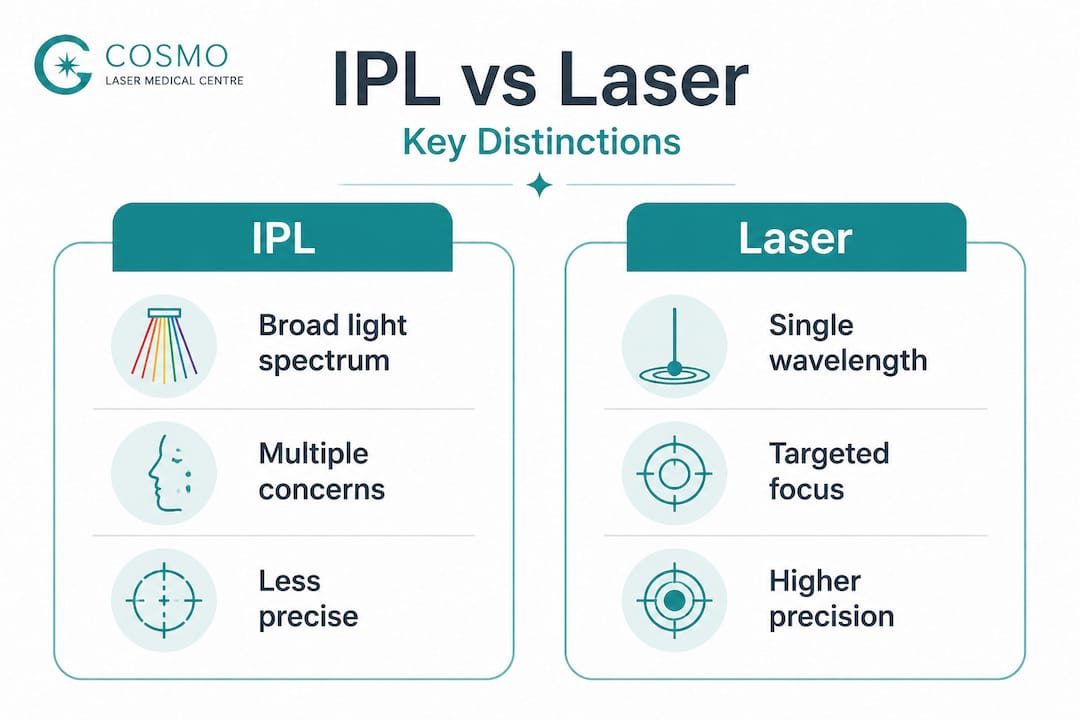
Compare that flexibility to a dedicated laser, which fires one wavelength at one target with extreme precision. For removing a single deep pigmentation spot or targeting a very specific skin structure, lasers often win. But for someone who wants overall skin rejuvenation, reduced acne, lighter sun spots, and finer pores from one course of treatment, IPL delivers something lasers cannot replicate as efficiently.
Research confirms this nuance. A comparison study found that IPL is less precise than lasers for deep or single-target concerns but excels in multi-concern treatments, with promising acne data when combined with topical products. This is the defining characteristic you should remember when evaluating your options.
Key uses of IPL therapy at a glance:
- Reducing acne lesions and active breakouts
- Fading sun spots, freckles, and hyperpigmentation
- Evening out skin tone and texture
- Reducing the appearance of redness and rosacea
- Permanent hair reduction (multiple sessions required)
- General skin rejuvenation and collagen stimulation
| Treatment goal | IPL suitability | Notes |
|---|---|---|
| Pigmentation and sun spots | High | Best for superficial pigment |
| Acne reduction | Moderate to high | Combine with topicals |
| Hair removal | Moderate | Works best on light skin, dark hair |
| Skin rejuvenation | High | Multi-wavelength advantage |
| Deep vascular lesions | Low | Dedicated laser preferred |
| Very dark skin types | Low | Risk of burns |
For a closer look at how advanced laser skincare compares to broad-spectrum approaches like IPL, the distinction becomes even clearer in a clinical setting.
Clinical results: IPL effectiveness for common skin concerns
Numbers matter when you are deciding whether to invest in a treatment course. So let's look at what the clinical data actually shows.
A controlled clinical study compared IPL against the Alexandrite laser for both acne and lentigines (flat brown spots). For acne, IPL delivered 74.1% total lesion reduction after 6 weekly sessions. For lentigines, IPL achieved 62.3% improvement, compared to 81.1% for the Alexandrite laser. The data is clear: IPL is a legitimate acne treatment and a solid pigmentation solution, though lasers edge it out for concentrated pigment removal.
What this means for you: If your primary concern is a single, well-defined dark spot, a laser may produce faster and more dramatic clearing. But if you want to tackle acne and uneven skin tone and general dullness in one treatment program, IPL's broader approach produces meaningful, clinically backed results across all three concerns simultaneously.
A typical IPL treatment course looks like this:
- Initial skin assessment and Fitzpatrick type evaluation with your provider
- Topical numbing cream applied 30 to 45 minutes before treatment
- Eye protection placed for both patient and provider
- Cooling gel applied to the treatment area
- IPL device pressed gently to skin, delivering pulses in overlapping passes
- Post-treatment cooling and SPF application
- Follow-up sessions scheduled at weekly or biweekly intervals (typically 4 to 6 sessions)
- Maintenance sessions once or twice per year as needed
| Skin concern | Average improvement with IPL | Sessions typically needed |
|---|---|---|
| Acne lesions | Up to 74.1% reduction | 6 weekly sessions |
| Lentigines (sun spots) | Around 62% improvement | 4 to 6 sessions |
| Skin redness/rosacea | 50 to 70% reduction | 3 to 5 sessions |
| Overall skin texture | Noticeable improvement | 3 to 6 sessions |
Knowing how to prevent pigmentation after treatments is essential, especially if you live in a sun-rich environment like the UAE where post-treatment exposure is nearly unavoidable. For those specifically exploring acne treatment options, IPL can be one effective layer within a broader protocol.
Who should get IPL: Skin type, safety, and contraindications
This section might be the most important one in this entire guide. IPL is not universally safe, and in a diverse country like the UAE, where skin tones range across the full spectrum, understanding suitability is critical.
IPL works by targeting melanin in the skin. The problem with darker skin types is that melanin is more abundant in the upper skin layers, making it harder for the light energy to discriminate between the pigment you want removed and the surrounding healthy skin. As a result, IPL risks for dark skin are significantly higher, including burns and post-inflammatory hyperpigmentation in Fitzpatrick types IV through VI.
The Fitzpatrick scale runs from I (very fair, burns easily) to VI (very dark, never burns). IPL is safest and most effective for types I through III. For types IV through VI, the risk of adverse effects increases substantially, and alternative treatments may be more appropriate.
Ideal candidates for IPL:
- Fitzpatrick skin types I to III
- Light to medium skin with dark hair (for hair removal)
- Individuals with sun damage, freckles, or mild to moderate acne
- People with rosacea or diffuse redness
- Patients not currently pregnant
- Those not taking photosensitizing medications (certain antibiotics, retinoids)
IPL is not recommended if you:
- Have recently tanned or have active sun exposure
- Are pregnant or breastfeeding
- Have active skin infections, cold sores, or open wounds in the treatment area
- Are undergoing cancer treatment or taking immunosuppressants
- Have a history of keloid scarring
- Have Fitzpatrick type IV to VI skin (without specialist assessment and adjusted settings)
Pro Tip: Always ask your provider to formally assess your Fitzpatrick skin type before any IPL session. A reputable clinic will document this and explain whether your skin tone requires adjusted settings, a test patch, or an alternative treatment entirely. If a provider skips this step, that is a red flag.
Understanding how to choose the right skin treatment for your specific skin type is the foundation of any successful aesthetic journey. Not every treatment is right for every patient, and safe cosmetic treatments always begin with proper skin type assessment.
What to expect: IPL treatment experience and aftercare in the UAE
Knowing what you are walking into helps you feel confident and prepared. Here is a realistic picture of what an IPL session feels like and what follows.
Step-by-step session walkthrough:
- You arrive at the clinic and have your skin cleansed of any makeup or sunscreen
- Numbing cream is applied and left on for 30 to 45 minutes
- You receive protective eye goggles
- Cool ultrasound gel is spread over the treatment area
- The provider moves the IPL handpiece across your skin in systematic passes
- Each pulse feels like a warm snap or rubber band flick on the skin surface
- Cooling may be applied between passes to keep you comfortable
- Session typically lasts 20 to 45 minutes depending on the area being treated
- Immediately after, treated skin may look slightly pink or red, similar to a mild sunburn
After the session, you can expect temporary redness and mild swelling that fades within 24 to 72 hours. Sun spots often darken slightly before they flake off and fade, which is a normal and expected process called "peppering." Do not pick at these areas.
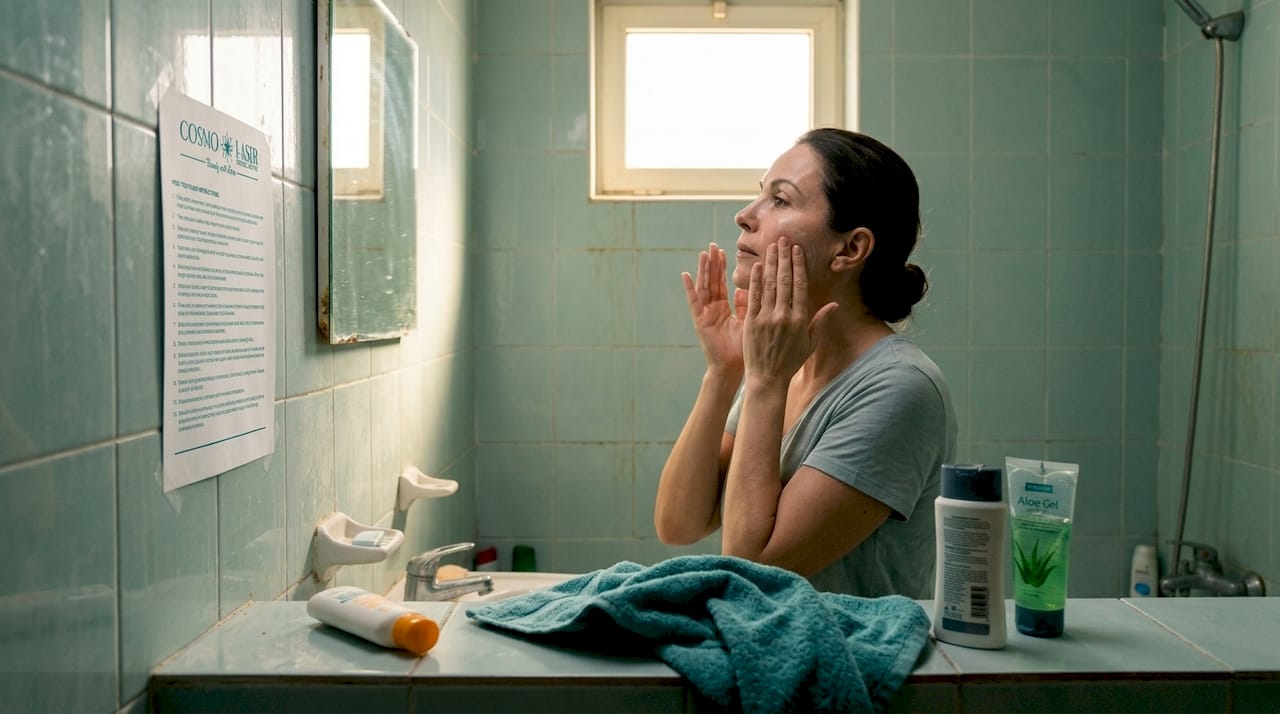
In the UAE, aftercare has a specific challenge that patients in cooler climates simply do not face: intense, year-round sun exposure. Even brief unprotected sun exposure after IPL can trigger post-inflammatory hyperpigmentation, undoing the treatment's benefits entirely. Proper post-treatment skin care makes a significant difference in your final results.
Essential aftercare steps for UAE patients:
- Apply SPF 50+ sunscreen every morning, reapplied every two hours if outdoors
- Avoid direct sun exposure for at least two weeks post-treatment
- Use gentle, fragrance-free cleansers and moisturizers
- Skip exfoliants, retinoids, and active acids for 7 to 10 days
- Stay out of heated pools, steam rooms, and saunas for 48 hours
- Wear a wide-brimmed hat when going outside
Pro Tip: In the UAE climate, aftercare is not optional. Treating skin with IPL and then exposing it to midday Sharjah sun without protection is counterproductive. Your provider should supply a customized aftercare plan. If they do not, ask for one in writing.
The dermatologist-level guidance on this is consistent: avoiding tanned skin, photosensitizing substances, and unprotected sun exposure before and after IPL is non-negotiable for safe outcomes.
IPL therapy versus popular treatments in the UAE
UAE residents have more aesthetic treatment options available now than at any other point in history. Understanding where IPL fits within that landscape helps you make a better-informed decision.
| Treatment | Best for | Limitation | Downtime |
|---|---|---|---|
| IPL | Multi-concern rejuvenation, acne, pigmentation | Not ideal for dark skin or deep targets | Minimal (1 to 3 days) |
| Fractional laser | Deep wrinkles, acne scars, skin resurfacing | More aggressive, longer recovery | 3 to 7 days |
| Chemical peel | Surface texture, mild pigmentation, acne | Sun sensitivity, not for all skin types | 3 to 10 days |
| Microneedling | Collagen stimulation, scars, pores | Does not address pigmentation directly | 1 to 3 days |
| HydraFacial | Hydration, surface cleansing, mild glow | No permanent structural change | None |
When reviewing must-know UAE skin treatments, IPL consistently stands out for its versatility. However, that versatility comes with the trade-off of reduced precision compared to single-wavelength laser skin treatments.
For patients who want top facial treatments that address multiple concerns without extended downtime, IPL often lands at the top of the list. But the right choice depends entirely on your individual skin concern, tone, and lifestyle.
Choose IPL when:
- You want to treat multiple concerns in one course
- Your skin falls in Fitzpatrick types I to III
- You have active acne plus pigmentation plus redness
- Minimal downtime is a priority
Consider alternatives when:
- You have a single deep scar or vascular lesion needing precision
- Your skin is Fitzpatrick IV to VI
- You want the most aggressive resurfacing possible
- You are dealing with active tan from recent sun or self-tanning products
A research comparison clearly supports IPL's strength in multi-concern protocols while confirming that dedicated lasers outperform it for isolated, deep targets. Knowing this distinction before booking a session saves time, money, and frustration.
The truth about IPL decisions: What most guides don't tell you
Here is something that gets glossed over in most IPL articles: generic advice is not just unhelpful in this context, it can be genuinely harmful.
We see a real pattern in the UAE aesthetic space where patients arrive having done their own research, confident that IPL is right for them, only to discover that their Fitzpatrick type IV or V skin requires a completely different approach. Generic blog posts that say "IPL works for pigmentation" without specifying the skin type caveat are doing readers a disservice.
The UAE is particularly complicated because the population is extraordinarily diverse. You have patients with very fair skin sitting next to patients with very deep skin tones in the same waiting room. A single standard protocol will not serve both of them well. IPL is genuinely excellent for the right candidate, but the consequences of applying it incorrectly go beyond just missed results. Burns and worsened hyperpigmentation are real outcomes when settings are not properly calibrated.
There is also a local climate factor that most international guides ignore entirely. IPL in a Northern European context, where post-treatment sun exposure is limited by weather and season, is a very different experience than IPL in Sharjah in June. The aftercare stakes are higher here. Post-treatment hyperpigmentation risk is elevated when skin that has just been treated with light energy faces intense daily UV exposure without adequate protection.
Our clinical perspective: the best IPL outcomes we see consistently come from patients who approach treatment as part of a structured skincare plan, not as a one-off procedure. Combining IPL with the right topical products, consistent sun protection, and follow-up care produces dramatically better long-term results than IPL in isolation. Making smart UAE treatment choices means embracing personalized, clinic-led planning rather than relying on generalized online advice.
Explore IPL and other leading skin treatments in Sharjah
If this guide has helped clarify whether IPL might be right for you, the natural next step is a proper consultation where your skin gets assessed individually, not compared to a generic standard.
At CosmoLaser Medical Center in Sharjah, we offer IPL skin rejuvenation tailored to your specific skin type, tone, and concerns. Our specialists assess your Fitzpatrick scale, discuss your goals, and build a treatment plan that may combine IPL with complementary options like acne scar chemical peels or targeted acne treatment protocols for comprehensive results. Whether your focus is pigmentation, active breakouts, or overall skin renewal, we provide the personalized guidance and clinical expertise UAE patients deserve. Book your consultation today and take the guesswork out of your skin decisions.
Frequently asked questions
Is IPL therapy safe for darker skin in the UAE?
IPL carries higher risk of burns and hyperpigmentation for Fitzpatrick types IV to VI due to increased melanin absorption; a specialist consultation is essential before proceeding.
How many IPL sessions are needed for acne or pigmentation?
Clinical protocols typically recommend 6 weekly sessions for significant acne reduction; pigmentation concerns may require additional sessions depending on depth and skin response.
Can I combine IPL with other skin treatments?
Yes, and it is often encouraged. Combining IPL with topical treatments and clinic-supervised skincare routines consistently produces stronger and more lasting results.
What should I avoid before and after IPL treatment?
Avoid tanned skin, photosensitizers, pregnancy, and active skin infections before IPL, and follow your clinic's specific post-treatment sun protection and skincare guidelines carefully.