
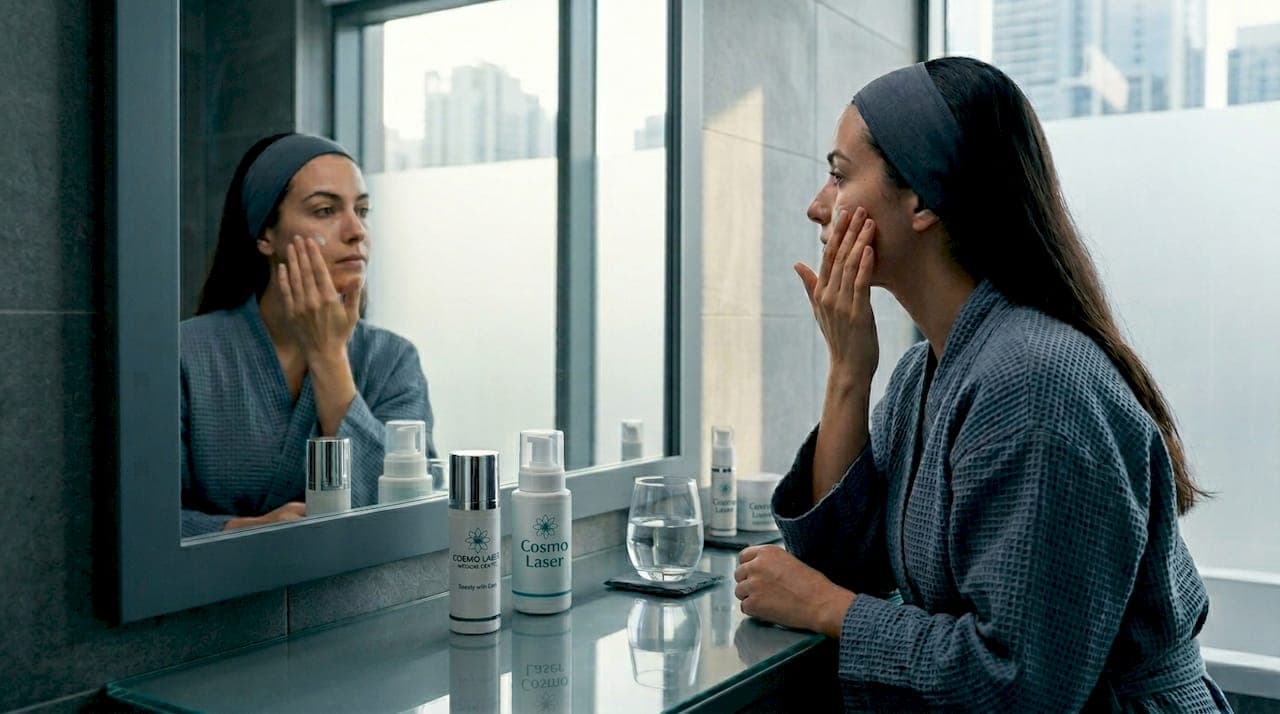
TL;DR:
- Post-HydraFacial skin is highly receptive; caring for hydration and sun protection is crucial.
- Avoid active ingredients and harsh products for at least 3 to 5 days, especially in UAE climate.
- Regular follow-ups and climate-adapted skincare routines help maintain and enhance treatment results.
You just stepped out of your HydraFacial session with that unmistakable post-treatment glow, and the last thing you want is to watch it fade within days. But in the UAE, where temperatures regularly exceed 40°C, humidity swings wildly between seasons, and air conditioning strips moisture from your skin around the clock, maintaining those results takes more than just good intentions. This guide walks you through exactly what to do in the hours, days, and weeks after your treatment, covering the right products, the common mistakes UAE residents make, and the smartest schedule for protecting your investment.
Table of Contents
- What to expect right after a HydraFacial
- Building your daily routine: Essential post-HydraFacial care steps
- Common mistakes: What to avoid after your HydraFacial
- Verifying results: When to seek advice and next steps
- Our take: Post-HydraFacial care that works in the UAE climate
- Discover next-level skincare solutions at Cosmolaser
- Frequently asked questions
Key Takeaways
| Point | Details |
|---|---|
| Initial aftercare matters | Following immediate post-HydraFacial instructions prevents irritation and maximizes treatment benefits. |
| Adapt routines for UAE | Use gentle cleansers, hydrating moisturizers, and SPF that fit the UAE’s climate to sustain glowing skin. |
| Avoid common errors | Skipping SPF or using harsh products too soon can undermine your facial results. |
| Seek expert advice | Consult a dermatologist if you experience lingering redness or need guidance for sensitive skin. |
What to expect right after a HydraFacial
Understanding what your skin is going through immediately after treatment helps you make smarter decisions and avoid panic when you see unexpected reactions. Your skin has just been cleansed, exfoliated, extracted, and infused with serums in a single session. That is a lot of work done in under an hour.
Immediate skin reactions
Most people notice a healthy flush or mild redness right after their session. This is completely normal and typically fades within a few hours. Your skin may also feel slightly tight or unusually smooth, almost like it has a new surface layer. Some patients describe it as the "glass skin" effect, and that is exactly what you are experiencing.
Here is a quick breakdown of what is normal versus what warrants attention:
| Reaction | Normal? | Typical duration |
|---|---|---|
| Mild redness or flushing | Yes | 2 to 4 hours |
| Skin feeling tight | Yes | Up to 24 hours |
| Minor breakouts (purging) | Yes, especially first session | 3 to 5 days |
| Swelling or hives | No | Seek advice immediately |
| Persistent burning sensation | No | Contact your provider |
For most people, the recovery timeline looks like this:
- Hours 0 to 4: Mild redness, heightened sensitivity, skin feels clean and smooth
- Hours 4 to 24: Redness subsides, skin begins to feel plump and hydrated
- Days 1 to 3: Glow peaks, skin texture visibly improved
- Days 3 to 7: Results stabilize, any minor purging resolves
"Your skin is in its most receptive state right after a HydraFacial. What you put on it in the first 24 hours matters more than any other time in your skincare routine."
Special guidance for sensitive and acne-prone skin
If you have sensitive or acne-prone skin, your post-treatment window requires extra caution. Sensitive and acne-prone skin may need a longer pause on active ingredients, up to five days, before reintroducing anything strong. Dermatologists also note that cystic acne patients may not be ideal HydraFacial candidates at all, so if you have active cystic breakouts, always consult your provider before booking.
For the first 24 to 48 hours after your session, you should also avoid:
- Hot showers or steam rooms (heat increases inflammation)
- Strenuous exercise (sweat can irritate freshly treated skin)
- Swimming pools or the sea (chlorine and salt water are harsh on open pores)
- Direct sun exposure without protection
Our post-treatment skin recovery guide covers these restrictions in more detail and explains the science behind each recommendation, which is worth reading before your next session.
Building your daily routine: Essential post-HydraFacial care steps
Once you understand what your skin is going through, the next step is building a practical daily routine that protects and extends your results. In the UAE, this routine needs to account for the climate in ways that standard aftercare guides simply do not address.
Step-by-step daily care
-
Cleanse gently, twice a day. Use a fragrance-free, sulfate-free cleanser that does not strip your skin's natural barrier. Avoid anything with physical scrub particles for at least a week. Lukewarm water only, never hot.
-
Apply a hydrating toner or essence. After cleansing, your skin is primed to absorb. A hyaluronic acid toner or essence locks in moisture before it can evaporate, which matters enormously in the UAE's dry, air-conditioned environments.
-
Layer a lightweight serum. Stick to calming, hydrating serums in the first 48 hours. Think niacinamide, peptides, or pure hyaluronic acid. These support your skin barrier without causing irritation.
-
Seal with a non-comedogenic moisturizer. Choose a gel-cream or lightweight lotion rather than a heavy cream. Heavy occlusives can trap heat and cause breakouts in a hot climate.
-
Apply SPF every single morning. This is not optional in the UAE. Use a broad-spectrum SPF 50 sunscreen, even if you are indoors, because UV rays penetrate windows.
-
Reapply SPF every two hours if outdoors. The UAE sun is intense year-round, and a single morning application is not enough if you are spending any time outside.
When to reintroduce active ingredients
This is where many people go wrong. Active ingredients like retinol, glycolic acid, and salicylic acid are powerful, but they are also irritating on freshly treated skin. Here is a simple comparison to guide your decisions:
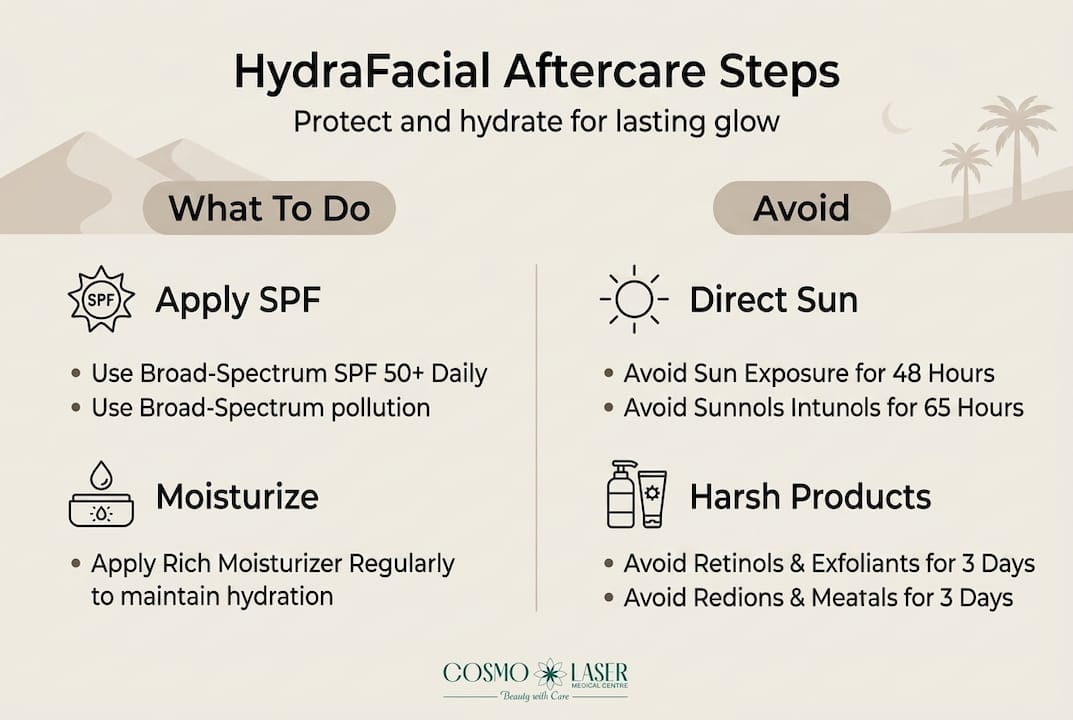
| Ingredient | Safe to resume | Notes |
|---|---|---|
| Hyaluronic acid | Immediately | Hydrating and non-irritating |
| Niacinamide | Day 1 to 2 | Calming and barrier-supporting |
| Vitamin C (L-ascorbic acid) | Day 2 to 3 | Start with lower concentrations |
| Retinol | Day 5 to 7 | Wait longer for sensitive skin |
| AHAs/BHAs (acids) | Day 5 to 7 | Sensitive skin may need up to 5 days or more |
| Physical exfoliants | 7 to 10 days | Avoid entirely for first week |
For more guidance on adapting your routine to the UAE environment, our UAE skin health tips article covers local environmental factors in depth. You can also explore our guide on facial treatments for radiant skin if you want to understand how HydraFacial fits into a broader treatment plan.
Pro Tip: Apply your moisturizer to slightly damp skin, not completely dry skin. This traps a thin layer of water against your skin's surface and dramatically improves hydration retention, which is critical in the UAE's dehydrating climate.
Common mistakes: What to avoid after your HydraFacial
Even patients who know the basics still fall into predictable traps. These mistakes are especially common in the UAE, where the environment creates unique temptations and pressures on your skin.
The biggest post-HydraFacial errors
-
Using harsh cleansers or toners with alcohol. Alcohol-based products strip your skin barrier right when it is trying to rebuild. Check ingredient labels carefully and set aside anything with denatured alcohol or witch hazel for at least a week.
-
Skipping SPF because you are indoors. This is one of the most common mistakes in the UAE. Offices, malls, and homes with large windows still expose your skin to UVA rays, which penetrate glass and cause long-term damage and pigmentation. SPF is non-negotiable every day.
-
Applying makeup within 24 hours. Your pores are open and your skin is actively absorbing. Foundation, concealer, and powder can clog pores and cause breakouts right when your skin is at its most vulnerable. Wait at least 24 hours, and when you do return to makeup, choose non-comedogenic formulas.
-
Hitting the gym too soon. Sweat contains salt and bacteria, both of which can irritate freshly treated skin. More importantly, the heat generated during intense exercise increases blood flow to the skin's surface, which can worsen redness and sensitivity. Skip the gym for at least 24 to 48 hours.
-
Sitting in direct sun or visiting the beach. The UAE sun is not forgiving. Even brief unprotected exposure in the first 48 hours post-treatment can cause hyperpigmentation (dark patches) on skin that is already in a heightened state. If you must go outside, wear a hat and reapply SPF.
-
Rushing back to active ingredients. The temptation to keep using your regular retinol or acid toner is understandable, but it is a mistake. As dermatologists note, acne-prone skin may need up to five days before restarting actives, and even non-sensitive skin benefits from a brief pause.
-
Over-touching your face. Your hands carry bacteria and oils that transfer easily. Touching your face frequently in the hours after treatment can introduce irritants to skin that is more permeable than usual.
Pro Tip: Keep a small facial mist with thermal water or rose water in your bag for the first few days after treatment. A light mist helps refresh your skin in the UAE heat without disrupting your SPF or moisturizer layers. Spray from at least 20 cm away and let it absorb naturally.
Our cosmetic treatment checklist UAE gives you a printable reference for pre and post-treatment dos and don'ts across multiple skin procedures, which is useful if you are combining treatments.
Verifying results: When to seek advice and next steps
Knowing how to track your results is just as important as knowing how to protect them. Many patients either expect too much too soon or miss early signs that something needs attention.
How to monitor your skin after treatment
Check in with your skin daily for the first week using these markers:
- Hydration levels: Your skin should feel plump and comfortable, not tight or flaky. If it feels dry despite moisturizing, increase your hyaluronic acid serum application.
- Texture: Smoothness should peak around day three and maintain itself with proper care. If texture worsens after day five, something in your routine may be irritating your skin.
- Tone evenness: Mild redness should resolve within hours. Any persistent redness or new discoloration after 48 hours deserves attention.
- Breakouts: Minor purging is normal, especially after a first session. But if breakouts are widespread, painful, or cystic, contact your provider. As dermatologists point out, cystic acne patients may not be ideal candidates for HydraFacial, and a different treatment approach may be more appropriate.
When to consult a professional
Seek advice from your provider if you experience any of the following:
- Redness or swelling that lasts more than 48 hours
- A rash, hives, or itching that was not present immediately after treatment
- Painful cystic breakouts appearing within three to five days
- Unusual peeling or skin shedding beyond light flaking
- A burning or stinging sensation that does not resolve within a few hours
Planning your follow-up schedule
For most patients, the ideal HydraFacial schedule is once every four weeks. This aligns with your skin's natural cell turnover cycle, which takes approximately 28 days. Monthly sessions allow each treatment to build on the last, progressively improving tone, texture, and hydration.
If you are targeting specific concerns like hyperpigmentation or fine lines, your provider may recommend pairing HydraFacial with complementary treatments. Options like microneedling, chemical peels, or LED therapy can significantly enhance and extend your results when timed correctly.
You can explore available HydraFacial options in Sharjah to see the specific protocols offered at CosmoLaser and discuss which combination approach suits your skin goals. For a broader look at what works well alongside HydraFacial, our guide on aesthetic treatments for skin rejuvenation outlines the most effective pairing strategies for 2026.
Our take: Post-HydraFacial care that works in the UAE climate
Most aftercare guides are written for temperate climates, and they show. Advice like "avoid excessive sweating" means something very different when you step outside in July in Sharjah and immediately start perspiring just walking to your car. The real challenge for UAE residents is not following a routine, it is adapting a routine to an environment that works against your skin at almost every turn.
What most guides miss is the indoor-outdoor skin stress cycle. You move from intense outdoor heat and UV exposure into aggressively air-conditioned spaces multiple times a day. This constant shift dehydrates your skin faster than almost any other lifestyle factor. After a HydraFacial, when your skin is at its most receptive, this cycle can either maximize your results or undo them quickly.
Our honest advice, drawn from seeing hundreds of patients at CosmoLaser: prioritize hydration over everything else in the first 72 hours. A good SPF is second. Everything else, including your serums and actives, matters less than those two steps. Explore our expert UAE skin health solutions for a deeper look at building a climate-smart skincare routine that actually holds up here.
Discover next-level skincare solutions at Cosmolaser
Your HydraFacial results are just the starting point.

At CosmoLaser Medical Center in Sharjah, our specialists design personalized treatment plans that go beyond a single session. Whether you are looking to maintain your glow with regular HydraFacial treatments or address deeper skin concerns with advanced skin resurfacing solutions, our team is ready to guide you. We combine clinical expertise with a genuine understanding of how the UAE climate affects your skin, so every recommendation is built for real life here, not a generic skincare template. Book a consultation and let us build a plan that keeps your skin performing at its best all year.
Frequently asked questions
How soon can I apply makeup after a HydraFacial?
Most professionals recommend waiting at least 24 hours to apply makeup after your HydraFacial to allow your skin to recover and reduce the risk of clogged pores.
When should I resume using retinol or exfoliating acids post-HydraFacial?
For most skin types, waiting three to five days is safe, but if your skin is sensitive or acne-prone, dermatologists advise waiting the full five days or longer before restarting actives.
Is HydraFacial suitable for cystic acne patients?
Dermatologists do not recommend HydraFacial for individuals with active cystic acne, as the treatment can aggravate inflamed lesions and worsen the condition.
What sun protection steps should I follow after my HydraFacial?
Apply a broad-spectrum SPF 50 sunscreen every morning and reapply every two hours if you are outdoors, as the UAE's intense UV index makes consistent sun protection essential for preserving your results and preventing pigmentation.