

TL;DR:
- Facial contouring in the UAE aims to restore balance and harmony between facial features using evidence-backed techniques. It involves procedures like fillers, thread lifts, fat reduction, and Botox, tailored to individual goals and cultural aesthetics. Successful outcomes depend on comprehensive facial assessment, personalized treatment plans, and realistic expectations rooted in clinical research.
Facial contouring is one of the most requested aesthetic treatments in the UAE, yet it's also one of the most misunderstood. Many people assume it's simply about making a round face look slimmer or adding volume to flat cheeks. The reality is far more nuanced. True facial contouring is a clinical art form focused on restoring balance and harmony between your features, using evidence-backed techniques that deliver results lasting months to years. This guide breaks down every major method, explains what the research actually shows, and helps you walk into any consultation with the right questions already in mind.
Table of Contents
- What is facial contouring and why does it matter?
- Overview of facial contouring procedures
- Evidence and outcomes: What does the research say?
- Common questions and considerations for UAE patients
- A professional perspective: What most people get wrong about facial contouring
- Take the next step with a trusted professional
- Frequently asked questions
Key Takeaways
| Point | Details |
|---|---|
| Balance over volume | The best facial contouring results come from harmonizing all features, not just adding filler. |
| Multiple methods available | Fillers, threads, and fat reduction each offer unique benefits for customizing your look. |
| Evidence supports satisfaction | Clinical studies show high patient satisfaction and safety for modern contouring procedures. |
| Mild side effects | Most treatments have only mild, temporary side effects such as swelling or bruising. |
| Expert consultation vital | A customized plan from a skilled professional ensures natural and safe results. |
What is facial contouring and why does it matter?
Facial contouring refers to a category of aesthetic procedures designed to enhance or restore definition to key facial structures: the cheeks, chin, and jawline. But here's where most people get it wrong. Contouring is not about adding volume for volume's sake. It's about evaluating the structural relationships between your features and bringing them into better proportion.
Think of your face like an architectural drawing. A skilled aesthetician doesn't just fill in empty spaces. They look at how one feature relates to another, how the chin projects relative to the nose, how wide the cheeks sit compared to the jaw, and how light falls across the midface. Every intervention is guided by that structural map.
Modern contouring focuses on overall balance rather than isolated changes. This shift in approach has dramatically improved outcomes over the past decade, especially as face fillers have become more sophisticated and practitioner training has improved. The most common goals patients bring to consultations in the UAE include:
- A sharper, more defined jawline
- Higher-looking or more projected cheekbones
- A more balanced chin that doesn't recede or protrude
- Reduction of submental fullness (commonly called a double chin)
- Overall facial symmetry and a more youthful structure
"Facial filler-based contouring improves patient satisfaction outcomes, especially for cheek symmetry."
The reason this matters for lasting results is simple. When you treat only one area without considering the whole face, you risk creating an imbalance that looks unnatural or makes another feature appear more prominent in the wrong way. True contouring always considers the big picture.
Overview of facial contouring procedures
With a clear understanding of what contouring means, here's how the major procedures compare in practice. The UAE aesthetic market offers excellent access to all of these methods, and the right choice depends on your goals, anatomy, and timeline.
| Procedure | Target areas | Duration of results | Downtime |
|---|---|---|---|
| Hyaluronic acid fillers | Cheeks, chin, jaw | 9 to 18 months | Minimal |
| Thread lifts | Jawline, midface | 1 to 2 years | 1 to 3 days |
| Fat reduction injections | Double chin | Permanent fat cell removal | Mild swelling |
| Botox jaw slimming | Masseter muscles, jaw width | 4 to 6 months | None |
Each procedure serves a distinct purpose, and many patients benefit from a combination approach. Here's how to think about selecting the right one:
- If your concern is volume loss or flat features, hyaluronic acid dermal fillers are typically the first-line option. They are reversible, predictable, and customizable to your facial structure.
- If your skin has started to sag or lose lift, thread lifts physically reposition tissue using dissolvable sutures placed under the skin. Results are visible within days.
- If you have submental fullness (a double chin) without significant skin laxity, injectable fat reduction targets the fat cells directly in that area.
- If your jaw appears wide due to muscle bulk, Botox injected into the masseter muscle gradually slims the lower face over several weeks.
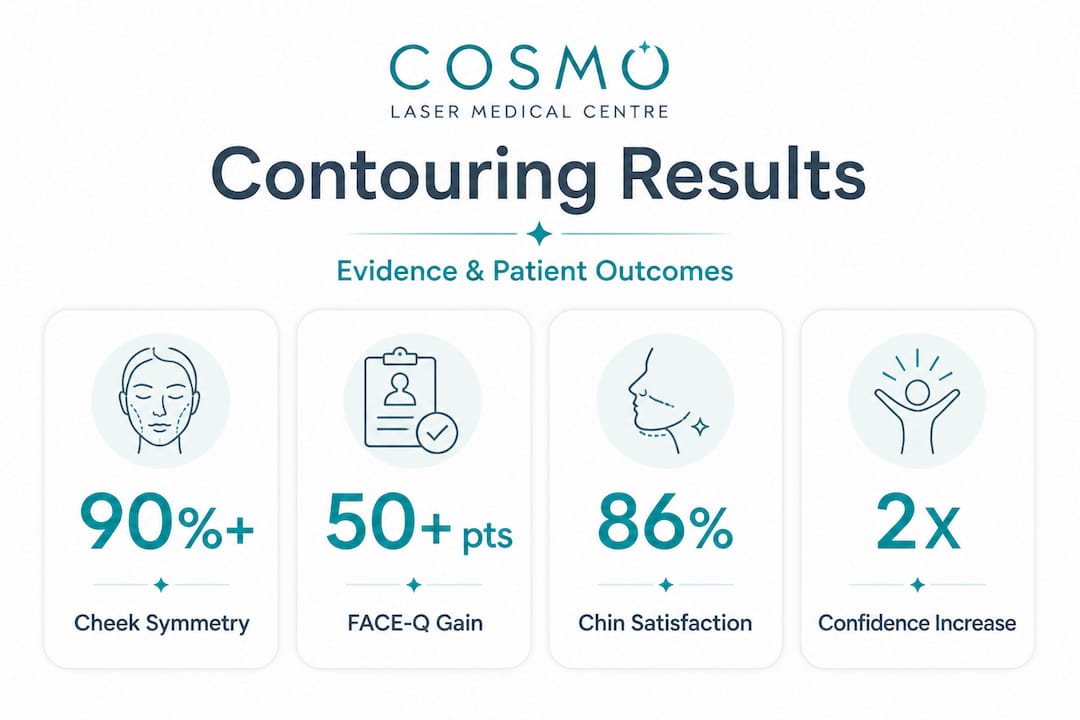
Cheek augmentation with fillers consistently delivers symmetry satisfaction rates exceeding 90% in clinical studies, which is one of the strongest satisfaction metrics in the entire field of aesthetic medicine.
Pro Tip: Don't choose your procedure based on what you've seen on social media. What works for one face shape can look completely wrong on another. Request a full facial mapping consultation before committing to any single treatment.
For a broader sense of what's available today, top facial treatments in the UAE now include everything from minimally invasive fillers to threads lifting techniques that can reposition drooping tissue without surgery.

Evidence and outcomes: What does the research say?
Clinical evidence for facial contouring procedures is stronger than many patients realize. This isn't a field built on before-and-after photos alone. There are well-designed studies measuring patient-reported outcomes using validated tools like the FACE-Q scale, which scores satisfaction with specific facial areas on a standardized questionnaire.
Here's a summary of the key clinical findings:
| Treatment | Outcome measure | Result |
|---|---|---|
| Cheek fillers | FACE-Q Satisfaction with Cheeks | Over 50-point increase at months 1 and 3 vs baseline |
| Submental fullness treatment | Clinician and patient-reported scales | Significant improvement, mild adverse events |
| Thread lift | Patient satisfaction surveys | High lift satisfaction at 6 and 12 months |
| Jawline filler | Symmetry assessment tools | Measurable improvement in facial harmony |
A 50-point increase on the FACE-Q scale is substantial. To put that in context, a 10-point change is generally considered clinically meaningful. Seeing scores jump by more than 50 points at both one month and three months after treatment tells us that patients aren't just happy immediately after the procedure. They're still happy months later when the initial swelling has completely resolved and they're seeing the true, settled result.
Submental fullness, the accumulation of fat under the chin, is another area where the evidence is compelling. Studies show that targeted treatment for double chin delivers significant improvements in both clinician-assessed and patient-reported outcomes. The psychological impact of this is notable too. Patients report improved confidence and reduced self-consciousness in photos and social settings after treatment.
Pro Tip: Ask your provider to show you before-and-after cases of patients with a similar face shape and skin type to yours. General results are helpful, but comparable cases give you a much more realistic picture of what to expect.
What makes this data particularly relevant for UAE patients is that the aesthetic standards and patient demographics in studies increasingly reflect diverse populations, including Middle Eastern facial structures. The midface, which tends to be fuller and more projected in many patients from the region, responds differently to filler placement than, say, a Northern European facial structure. A provider who understands this distinction will approach your treatment plan very differently.
Common questions and considerations for UAE patients
Choosing to pursue facial contouring involves more than just picking a procedure. There are practical and personal factors that shape whether you'll get the result you want. Here are the questions UAE patients most often raise in consultations, along with honest answers.
Who benefits most from facial contouring?
Contouring works well across a wide range of patients. Younger patients in their 20s and early 30s often seek definition they feel they were never born with, such as a more defined jawline or higher cheekbones. Patients in their 40s and 50s are more often looking to restore volume and lift that has diminished with age. Men represent a growing share of contouring patients in the UAE, typically seeking a stronger jaw or reduced double chin. Different must-know aesthetic treatments apply to different profiles, and the right starting point depends on your specific anatomy and goals.
What side effects should you realistically expect?
This is where honest communication matters. Most side effects from injectable contouring treatments are:
- Mild bruising at injection sites, usually fading within 3 to 7 days
- Temporary swelling, which is normal and typically resolves within a week
- Tenderness around treated areas for a few days post-treatment
- Rare firm nodules (lumps) under the skin, which a skilled provider can dissolve if needed
Side effects for submental treatments are consistently described in the literature as mild and injection-site related, meaning they are localized and short-lived. Serious complications are rare and almost always linked to untrained injectors or incorrect technique.
What role does cultural aesthetics play?
This is one of the most underappreciated factors in facial contouring outcomes. Aesthetic ideals in the UAE and across the Middle East often emphasize a pronounced midface, a well-defined nose projection in profile, and a strong jawline. These preferences differ from trends seen in Western aesthetic practices, and they should directly influence how and where a practitioner places filler or positions threads. A provider who understands the cultural context of beauty in the UAE will ask different questions and design a different treatment plan than one applying a universal template.
Pro Tip: During your consultation, specifically ask your provider how they customize their approach for your facial structure and background. A vague answer is a red flag. A confident, specific answer shows real expertise.
A professional perspective: What most people get wrong about facial contouring
After working with hundreds of patients across the UAE, a pattern becomes very clear. The people who are least happy with their results are the ones who came in with a single area in mind and left without a full picture of what was really happening across their face.
The most common mistake is treating contouring like a local fix. A patient wants higher cheeks, so they get cheek filler. Six months later, they notice their chin looks recessed and their jaw appears wider by comparison. They didn't do anything wrong. Their provider did. A skilled practitioner assesses the whole facial profile before touching a syringe.
The research is very clear on this. Contouring results depend on correct assessment of facial planes and the relationship between cheeks, chin, and jaw angles, not on volume change alone. Adding more filler is not always the answer. Sometimes the right answer is a tiny adjustment in one area that changes how three other features look.
Volume is a tool. It is not the goal. The goal is always harmony. The patient who walks out looking naturally better, where no one can quite put their finger on what changed but everyone notices they look refreshed and balanced, that is the result every practitioner should be working toward. Chasing trends or mimicking a celebrity's face is the opposite of good contouring.
This is why facial rejuvenation as a concept has evolved so significantly. It now centers on the individual, their unique proportions, their cultural aesthetic, and their long-term goals, rather than a generic template of what an "ideal" face looks like.
Take the next step with a trusted professional
If you're ready to put these insights into practice, expert guidance is just a step away. At CosmoLaser Medical Center in Sharjah, our experienced aesthetic specialists take a structured, individualized approach to every facial contouring consultation. There's no cookie-cutter treatment plan here.

Whether you're exploring face filler services for cheekbone definition, dermal fillers for overall facial balance, or threads lifting for repositioning and tightening, we start with a full facial assessment to understand your proportions and goals. Our team is trained to work with the diverse facial structures and aesthetic preferences of UAE patients, giving you a result that looks natural, not overdone. Book your consultation today and find out exactly which approach is right for you.
Frequently asked questions
How long do facial contouring results last?
Results depend on the technique used. Fillers typically last 9 to 18 months, while thread lifts can maintain their effect for 1 to 2 years before a touch-up is needed.
Is facial contouring safe?
Facial contouring treatments are generally very safe when performed by trained professionals. Most adverse events are mild, temporary, and injection-site related, such as bruising or brief swelling.
Who is a good candidate for facial contouring?
Healthy adults with realistic expectations who want better definition or improved balance in their facial features are ideal candidates. A professional consultation determines the best approach for your specific anatomy.
What areas of the face can be contoured?
The cheeks, jawline, chin, and submental area (double chin) are the most commonly treated zones. In some cases, the temples and nose bridge are also addressed as part of a full facial balance plan.
What should I discuss with my provider before treatment?
Bring up your specific goals, any prior facial procedures, your overall health status, and any medications you're taking. This information helps your provider design the safest and most effective treatment plan for you.