

TL;DR:
- Structured aesthetic consultations significantly improve safety, personalization, and patient satisfaction.
- Proper consultations include medical history, skin analysis, goal-setting, and psychological screening.
- In the UAE, regulations hold clinicians accountable for results, emphasizing ethical, individualized care.
Most people think of an aesthetic consultation as a quick chat before the real treatment begins. That assumption is costing patients real results. In the UAE's fast-growing cosmetic dermatology market, a structured consultation is not a formality. It is the single most powerful step that determines whether your treatment is safe, personalized, and genuinely effective. Whether you are exploring laser treatments, Botox, or chemical peels for the first time, understanding what a proper consultation does for your outcome changes everything about how you approach cosmetic skin care.
Table of Contents
- Why aesthetic consultations matter: More than a routine step
- What happens during an aesthetic consultation?
- Safety, ethics, and UAE regulations: What protects patients?
- Personalized planning: How consultations drive better results
- The real value of aesthetic consultations: Practical wisdom and industry blind spots
- Ready for your personalized, safe aesthetic consultation in the UAE?
- Frequently asked questions
Key Takeaways
| Point | Details |
|---|---|
| Consultations boost satisfaction | Patients report higher satisfaction and retention after structured consultations. |
| Safety and ethics enforced | UAE regulations require medical practitioners to ensure safety and ethical standards via consultations. |
| Personalization delivers results | Customized planning during consultations leads to natural, culturally refined outcomes. |
| Psychological screening matters | Consultations include screening for psychological risks, improving patient safety and satisfaction. |
| Choose reputable clinics | Opt for clinics with formal assessment practices and licensed medical staff for the best cosmetic skin outcomes. |
Why aesthetic consultations matter: More than a routine step
The consultation is where your entire treatment journey is built. Skip it, rush through it, or treat it as a box-checking exercise, and you are starting a process designed for someone else, not for you. The numbers make this point clearly.
Research into formal consultation models shows that patients who go through structured facial assessments have a 2.5-fold higher chance of being retained as long-term patients compared to those who do not. This matters because cosmetic skin treatments often work best across a series of sessions. A patient who stays engaged with a clinic gets compounding benefits over time.
"Post-implementation 6-month retention reached 70.81% in clinics with structured consultation models, demonstrating that formal planning directly supports patient loyalty and outcome tracking."
Satisfaction scores tell a similar story. Mean FACE-Q scores improve measurably following aesthetic treatments that were planned through thorough consultations, with overall satisfaction rates reaching 69% even in surgical cases. Non-surgical treatments, which carry less risk and more flexibility, tend to score even higher when paired with proper pre-treatment planning.
Here is what structured consultations concretely deliver for you as a patient:
- Safety screening: Identifies contraindications before any device touches your skin
- Personalized planning: Matches treatment intensity and type to your specific skin type, tone, and goals
- Realistic expectations: Prevents disappointment by aligning your expectations with what treatments can realistically achieve
- Retention and follow-up: Creates a roadmap for ongoing care rather than one-off sessions
- Ethical foundation: Ensures you are making an informed, voluntary decision rather than being pushed toward unnecessary treatments
Understanding consultation benefits UAE patients receive goes beyond the treatment room. A good consultation sets the tone for a transparent, respectful relationship between you and your practitioner.
What happens during an aesthetic consultation?
Knowing what to expect removes the anxiety many first-time patients carry into a consultation. The process is structured, methodical, and designed to protect you as much as it is designed to plan your treatment.
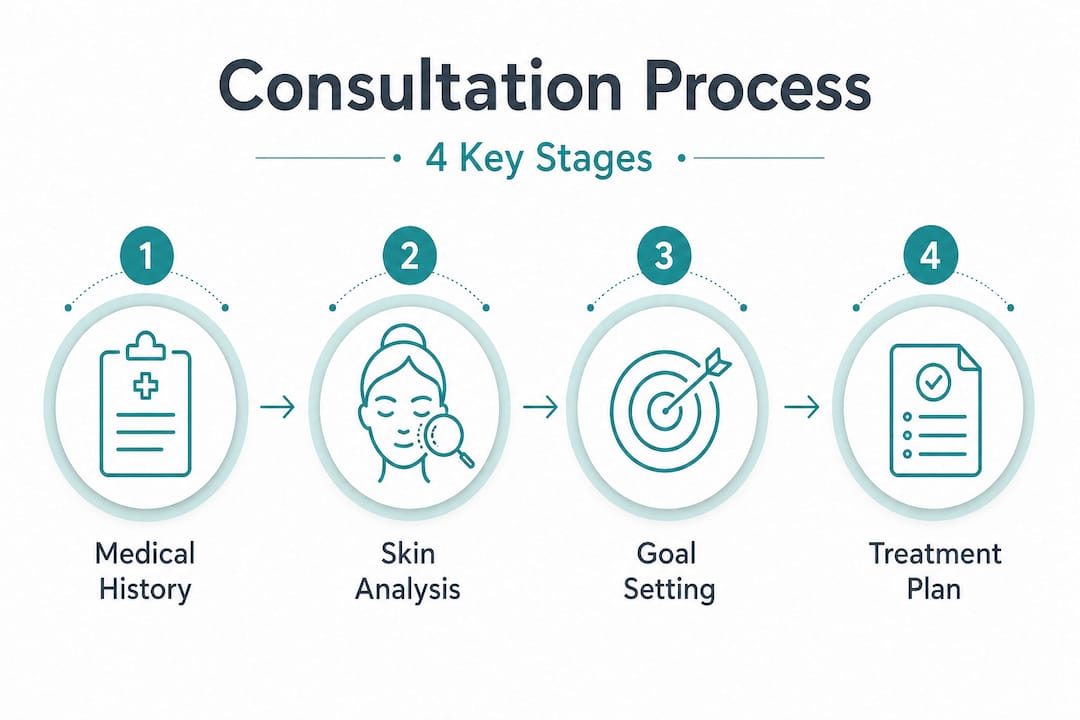
Here is a typical stepwise breakdown of what happens during your first aesthetic consultation at a reputable UAE clinic:
- Medical history review: Your practitioner collects information about your health conditions, medications, allergies, and previous treatments. This step is non-negotiable.
- Skin analysis and diagnostics: Using clinical tools or imaging technology, your skin is assessed for texture, pigmentation, hydration, and underlying concerns.
- Goal-setting conversation: You describe what you want to achieve. This is where the Gulf preference for refinement over drastic transformation is often explored openly.
- Psychological screening: Reputable clinics screen for signs of body dysmorphic disorder (BDD), a condition where a person fixates on perceived flaws that others do not notice. Treating a patient with undiagnosed BDD leads to dissatisfaction regardless of how technically successful the procedure was.
- Treatment plan presentation: Based on all the above, your practitioner presents an evidence-based plan, explains what each step involves, and discusses expected timelines and results.
- Consent and questions: You review the risks, alternatives, and realistic outcomes before giving informed consent.
The table below shows how different consultation inputs shape the final treatment plan:
| Customization factor | What it influences |
|---|---|
| Medical history | Rules out contraindicated treatments |
| Skin diagnostics | Guides device settings, peel strength, or filler volume |
| Psychological screening | Determines readiness and realistic outcome expectations |
| Personal aesthetic goals | Anchors the plan to what actually matters to you |
| Cultural and lifestyle factors | Ensures treatment fits your daily routine and values |
Research shows that consultations must balance personalization with ethics, using diagnostics for evidence-based plans while also accounting for psychological factors. In the Gulf region specifically, patients tend to prefer refinement over drastic change, so practitioners frame their plans around enhancement rather than transformation.
Pro Tip: Before your consultation, write down three specific things you want to improve and three things you want to keep exactly as they are. Bringing this list gives your practitioner a clearer picture of your goals and helps them design a plan that respects what you already love about your appearance.
Learn how to approach booking aesthetic appointments safely and what to ask before you even walk through the door. If you are already thinking ahead to specific treatments, reviewing guidance on scheduling safe treatments UAE will help you prepare with confidence.
Safety, ethics, and UAE regulations: What protects patients?
The UAE takes cosmetic treatment safety seriously at a regulatory and legal level. Understanding your rights as a patient helps you choose the right clinic and ask the right questions.
A landmark Gulf News report revealed that UAE courts hold surgeons accountable for aesthetic outcomes specifically, not just general duty of care. The ruling established that elective cosmetic procedures must improve the patient's condition without introducing new risks.
"Cosmetic surgeons in the UAE are now legally responsible for results, not just process. This shifts the standard from 'we followed procedure' to 'did the patient genuinely benefit?'"
This legal context changes how reputable clinics operate. Ethical clinics build their consultation process around this accountability. Here is what patient-protective screening looks like in practice:
- Screening for body dysmorphic disorder: Patients flagged during screening may be referred to psychological support before treatment proceeds
- Documentation of psychiatric history: Clinics record relevant mental health history as part of the planning process
- Avoiding unnecessary upselling: Ethical consultations focus on what you need, not what generates the most revenue
- Clear risk communication: All known side effects and contraindications are explained before consent is signed
- Post-treatment follow-up protocols: Reputable clinics track outcomes and intervene quickly if complications arise
Research on ethical dilemmas in aesthetic practice confirms that non-medical practitioners performing injectables and consultations raise significant safety concerns, and that psychiatric history lowers satisfaction outcomes when not properly addressed before treatment.
| Responsibility area | Medical practitioner | Non-medical practitioner |
|---|---|---|
| Diagnosing contraindications | Fully qualified | Limited or not qualified |
| Prescribing injectables | Authorized | Not legally authorized in UAE |
| Psychological screening | Part of training | Rarely performed |
| Legal accountability | Full | Minimal or unclear |
| Emergency response | Trained | Typically untrained |
Use a safe skin care checklist UAE patients rely on to vet any clinic before booking. If you want a deeper look at how to verify clinic credentials and practitioner qualifications, guidance on ensuring treatment safety walks you through every step. Understanding the dermatology workflow UAE clinics follow gives you a strong benchmark for comparison.
Personalized planning: How consultations drive better results
The most visible benefit of a well-run consultation is the quality of results it produces. When your treatment plan is built on real diagnostics and honest goal-setting rather than a generic package, the outcomes look and feel more natural.

In the Gulf region, evidence-based personalized planning respects the cultural tendency toward subtle refinement. Patients here are not typically looking for dramatic overhaul. They want to look like the best version of themselves, not a different person entirely. A good consultation captures this.
Here are the aesthetic preferences that Gulf patients most commonly bring to consultations, and which inform how personalized plans are structured:
- Enhancement over alteration: Most patients want to amplify existing features, not replace them
- Skin tone preservation: Treatments are selected to respect natural complexion, particularly important for deeper skin tones common in the MENA region
- Subtle volume adjustments: Filler placements aim for natural restoration rather than exaggerated volume
- Minimal social downtime: Treatment schedules are built around daily commitments and social calendars
- Long-term skin health: Plans often prioritize progressive improvement over dramatic short-term results
Pro Tip: Ask your practitioner to show you diagnostic images or simulations of expected results before treatment. Seeing a visual reference gives you a much clearer sense of whether the planned approach aligns with your goals, and it gives the practitioner a chance to reset expectations before, not after, the procedure.
For UAE residents looking to make a real difference in their skin quality, exploring cosmetic dermatology tips designed for this region gives you a strong foundation before your consultation even begins.
The real value of aesthetic consultations: Practical wisdom and industry blind spots
Here is something the aesthetic industry does not talk about enough. Commercial pressure inside busy clinics can quietly erode the quality of a consultation. When revenue targets drive appointment scheduling, consultations get shorter, screening gets lighter, and patients end up with plans that serve the clinic's interests more than their own skin.
We see this pattern often in markets where cosmetic treatments have become high-volume services. The consultation becomes a sales conversation instead of a clinical assessment. The patient leaves with three treatments booked and no real understanding of why those three were chosen for them specifically.
The emerging use of AI in aesthetic planning introduces another blind spot. Research on bias and cultural sensitivity in aesthetic practice reveals that AI-driven beauty assessment tools often default toward Western aesthetic standards. For MENA patients, who value subtle refinement and whose skin tones, facial structures, and cultural preferences differ significantly from Western norms, this creates a real risk of misaligned treatment recommendations.
"When algorithms trained on predominantly Western datasets guide aesthetic plans for Gulf patients, the result is often recommendations that feel foreign to what those patients actually want."
The solution is not to abandon technology. It is to demand that technology serves your specific context. At medical aesthetics safe UAE clinics, the consultation process is built around the individual, not a demographic average.
Pro Tip: If a clinic cannot explain why a specific treatment was chosen for your skin type, tone, and personal goals, that is a warning sign. A proper, evidence-based consultation should produce a plan you can understand and agree with on your own terms.
The bottom line is this: the quality of your consultation determines the quality of your results. Not the brand of the laser. Not the price of the filler. Not the size of the waiting room. A rigorous, personalized, ethics-first consultation is the single most reliable predictor of whether you will walk away satisfied.
Ready for your personalized, safe aesthetic consultation in the UAE?
Everything covered in this article points toward one practical next step: working with a clinic that takes consultations seriously. At CosmoLaser Medical Center in Sharjah, every patient journey starts with a thorough, individualized assessment before any treatment is recommended.
Whether you are interested in laser hair removal treatments, considering Botox in the UAE, or exploring chemical peels for your skin, the process always begins with understanding your skin, your goals, and your health profile in detail. Our team of experienced specialists uses the latest diagnostic tools to build plans that reflect who you are, not a generic template. Book your consultation today and experience the difference that personalized, evidence-based aesthetic care makes.
Frequently asked questions
Why are consultations required before cosmetic treatments in the UAE?
Consultations are legally and ethically required to ensure treatments are safe and tailored to each patient. UAE courts hold surgeons accountable for outcomes specifically, meaning clinics must demonstrate that every procedure was appropriate and beneficial for that individual patient.
What can I expect in my first aesthetic consultation?
Your first consultation will include a medical history review, skin diagnostics, goal-setting, and screening for psychological risk factors. Evidence-based consultation models in the Gulf emphasize personalization and subtle refinement, so your plan will be built around your actual goals rather than a standard treatment menu.
Are only doctors allowed to perform consultations and injectables?
In the UAE, only qualified medical practitioners are legally authorized to prescribe and administer injectables. Research on ethical dilemmas in aesthetic practice confirms that non-medical practitioners performing these procedures raise serious safety concerns that put patients at risk.
How do consultations affect treatment satisfaction and results?
Formal, structured consultations are directly linked to higher satisfaction outcomes. Patients assessed through structured facial consultation models report better experiences, higher FACE-Q scores post-treatment, and stronger long-term retention with their chosen clinic.