

TL;DR:
- Laser hair removal offers long-lasting hair reduction by targeting follicles with focused light energy.
- It is safer and more effective for a variety of skin tones with modern laser technology.
- Multiple sessions are necessary for optimal results, and proper preparation enhances safety and efficacy.
Shaving every few days, booking waxing appointments every three weeks, dealing with ingrown hairs and razor burn — for millions of people, this cycle never ends. Traditional hair removal methods are effective in the short term, but none of them offer lasting results. Laser hair removal changes that equation entirely. Using focused light energy to target hair at the root, it delivers long-term reduction that shaving and waxing simply cannot match. This guide covers how the treatment works, how it compares to traditional methods, who it's safe for, and exactly what to expect before and after your first session.
Table of Contents
- How laser hair removal works
- Comparing laser hair removal to traditional methods
- Is laser hair removal safe for everyone?
- Preparing for your first laser session: What to expect
- Our expert perspective: What most guides miss about laser hair removal
- Ready to experience smooth, confident skin?
- Frequently asked questions
Key Takeaways
| Point | Details |
|---|---|
| Long-term solution | Laser hair removal offers lasting hair reduction and is more effective than waxing or shaving. |
| Safe for all skin types | Modern lasers can treat light and dark skin safely, making the procedure accessible in the UAE. |
| Multiple sessions needed | You’ll get the best results across several appointments, with visible improvement after each. |
| Choose expert providers | Experience and proper technology are key to safe, successful outcomes. |
How laser hair removal works
Laser hair removal is not magic — it's physics. A laser emits a concentrated beam of light that is absorbed by melanin, the pigment that gives hair its color. That light energy converts to heat, which damages the hair follicle and disrupts its ability to regrow hair. The follicle isn't always destroyed in a single session, which is why multiple treatments are necessary.
One of the most important distinctions to understand is the difference between permanent removal and permanent reduction. No treatment can guarantee that every single hair will never return. What laser hair removal does deliver is a significant, lasting reduction in hair density and regrowth speed. Laser technology targets the hair follicle and reduces regrowth by 65% to 75% after several sessions — that's a meaningful, life-changing result for most people.
A typical session looks like this:
- A trained technician maps the treatment area and adjusts the laser settings for your skin and hair type.
- A cooling gel or built-in cooling tip is applied to protect the skin surface.
- The laser handpiece is moved across the area in systematic pulses.
- Sessions range from 10 minutes (upper lip) to over an hour (full legs or back).
- You leave with no downtime and minimal redness.
The most commonly used laser types are Alexandrite and Diode. Alexandrite lasers work best for lighter to medium skin tones, while Diode lasers are better suited for darker skin. Both are widely used and well-tested. Understanding how laser technology works helps you ask better questions when you consult a provider.
Treatment areas include the face, underarms, arms, legs, back, chest, and bikini line. Virtually any area with unwanted hair can be treated safely.
"The goal is not to eliminate every hair permanently but to dramatically reduce regrowth so that maintenance becomes minimal and manageable."
Pro Tip: Hair grows in cycles, and lasers only affect follicles in the active growth phase. Spacing your sessions 4 to 6 weeks apart ensures you catch each follicle at the right stage.
Comparing laser hair removal to traditional methods
Understanding the science is important, but seeing how laser hair removal stacks up to other common methods will help you make an informed decision.
Here's a straightforward comparison:
| Method | Pain level | Frequency needed | Duration of results | Common side effects | Long-term cost |
|---|---|---|---|---|---|
| Shaving | None | Every 2-5 days | Days | Razor burn, ingrowns | Low per use, high overall |
| Waxing | Moderate | Every 3-6 weeks | Weeks | Redness, irritation | Moderate to high |
| Threading | Moderate | Every 2-4 weeks | Weeks | Redness, irritation | Moderate |
| Laser | Mild | 6-8 sessions total | Months to years | Temporary redness | Higher upfront, lower long-term |
Alexandrite lasers achieve about 74% hair reduction for lighter to medium skin, while Diode lasers produce around 65% for darker skin types. No waxing appointment comes close to those numbers.
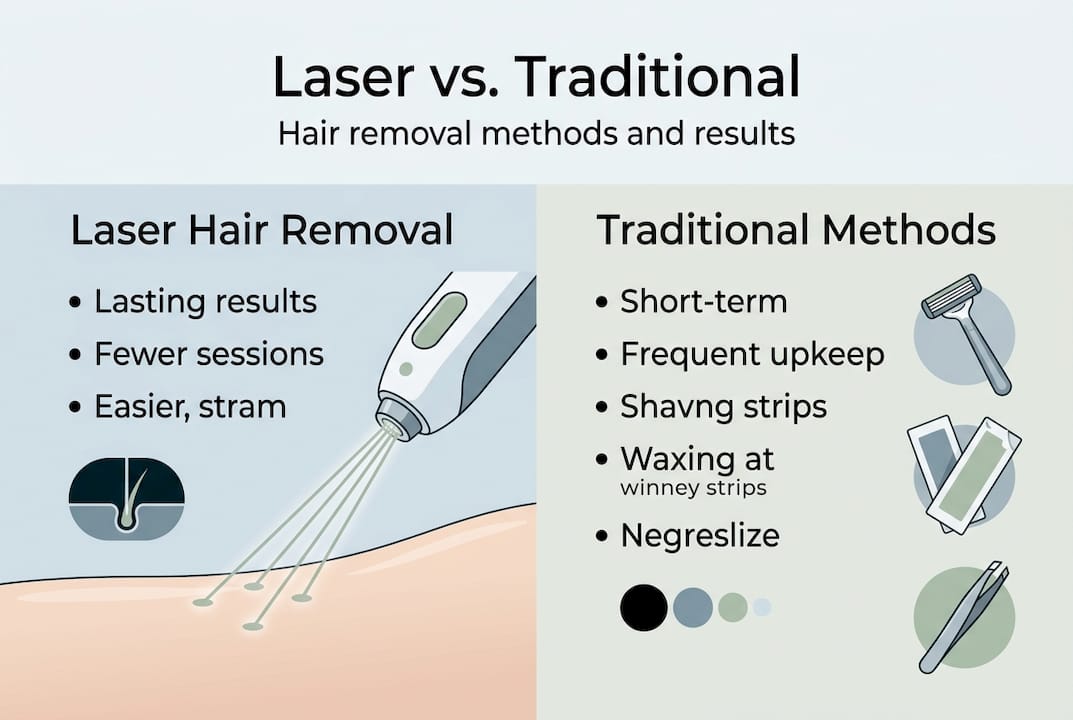
The laser hair removal benefits go beyond just numbers. Here's a quick breakdown:
Laser advantages:
- Long-lasting reduction with minimal maintenance after completing sessions
- No risk of cuts or nicks
- Reduces ingrown hairs significantly
- Works on large areas quickly
- Cost-effective over a 2 to 3 year period
Traditional method drawbacks:
- Results last days to weeks at most
- Frequent appointments add up in cost and time
- Higher risk of skin irritation and ingrown hairs
- Not suitable for sensitive skin areas long-term
In the UAE's hot, humid climate, the appeal of laser is even stronger. Wearing light clothing year-round means body hair visibility is a daily concern. Spending an hour in a waxing salon every few weeks isn't just inconvenient — it adds up financially. Exploring safe and effective skin treatments available locally can help you find the right fit for your lifestyle.

Is laser hair removal safe for everyone?
Having covered how lasers compare to other methods, let's address the most common concerns about who can safely benefit from this treatment.
Safety is the first question most people ask, and rightly so. The answer depends largely on your skin type, which is classified using the Fitzpatrick scale — a six-level system ranging from Type I (very fair, burns easily) to Type VI (very dark, never burns). This scale helps clinicians choose the right laser and settings.
| Fitzpatrick type | Skin description | Recommended laser | Safety level |
|---|---|---|---|
| I-II | Very fair to fair | Alexandrite | High |
| III-IV | Medium to olive | Alexandrite or Diode | High |
| V-VI | Brown to dark brown | Diode or ND:YAG | High with proper settings |
The UAE population includes a wide range of skin tones, particularly Types IV through VI. The good news is that modern laser technology has kept pace. Diode lasers achieved 57% reduction for Sudanese patients with skin types IV-VI after only three sessions — a result that would have been considered difficult to achieve with older laser systems.
"Modern Diode and ND:YAG lasers have made laser hair removal genuinely accessible for darker skin tones, provided the settings are calibrated by an experienced professional."
Who is not an ideal candidate? People who are pregnant, those on certain photosensitizing medications, and individuals with active skin infections in the treatment area should wait or consult a doctor first. Hormonal conditions like PCOS can also affect results, though treatment is still possible.
For full details on what makes you a suitable candidate, reviewing laser hair removal details and checking specific preparation tips before booking is a smart move.
Pro Tip: Always ask your provider which laser they use and whether they have experience treating your specific skin type. This single question filters out under-qualified clinics fast.
Preparing for your first laser session: What to expect
Once you know if you're a candidate, the next step is preparing for your first session — you'll want to know how to maximize results and minimize nerves.
Multiple sessions, typically 6 to 8, are needed for optimal results sustained over many months. Each session targets a different batch of follicles in their active growth phase, which is why skipping appointments or stopping early significantly reduces your final outcome.
Here's what the process looks like from start to finish:
- Two weeks before: Stop waxing, threading, or plucking. The laser needs the hair root to be present in the follicle.
- 24 hours before: Shave the treatment area. This removes surface hair while keeping the follicle intact underground.
- One week before and after: Avoid direct sun exposure. Tanned or sunburned skin increases the risk of irritation.
- Day of treatment: Arrive with clean, product-free skin. No deodorant on underarms, no lotion on legs.
- During the session: You'll feel a mild snapping or warmth sensation. Most people find it very tolerable, especially with cooling technology.
- After treatment: Expect mild redness for a few hours. Apply aloe vera or a gentle moisturizer. Avoid hot showers and the gym for 24 hours.
- Days 5 to 14: Treated hairs shed naturally. This is not regrowth — it's the process working.
Results build gradually. After your second or third session, you'll notice patchier, finer regrowth. By session five or six, many areas feel almost hair-free. Reviewing how to prepare in detail and checking scheduling tips for UAE residents will help you plan your sessions around travel and sun exposure.
Pro Tip: Schedule your sessions between October and March in the UAE when sun exposure is lower. This reduces the risk of post-treatment pigmentation and makes aftercare much easier.
Our expert perspective: What most guides miss about laser hair removal
Most articles on laser hair removal focus on the positives — and there are many. But after working with patients across a wide range of skin types and concerns, we've noticed a pattern: the people who are most disappointed are the ones who came in with expectations shaped by marketing, not medicine.
Laser hair removal works. The data is clear. But results are not uniform. Your outcome depends on your hair color, skin type, hormonal profile, and whether you complete the full treatment plan. Patients who stop after three sessions and then say "it didn't work" are like someone who quits a fitness program halfway through and blames the gym.
In the UAE specifically, sun exposure is a real variable. Skipping SPF between sessions or getting a tan mid-treatment can compromise both safety and results. The benefits of laser treatments are real, but they require commitment and a personalized plan from a provider who actually knows your skin. Choose your clinic based on experience and transparency, not just price.
Ready to experience smooth, confident skin?
If you've spent years managing unwanted hair with temporary fixes, it may be time to explore a longer-term solution. At CosmoLaser Medical Center in Sharjah, we specialize in laser hair removal for all skin types, including the diverse tones common across the UAE.
Our team uses advanced Diode and ND:YAG laser systems calibrated for your specific skin and hair profile. Whether you're targeting your face, legs, back, or bikini line, we build a personalized treatment plan designed around your goals and schedule. Explore our full range of hair removal in Sharjah or take the first step and book your laser session today. Real results start with the right team.
Frequently asked questions
How many laser sessions are needed for lasting results?
Most people need 6 to 8 sessions for optimal, sustained results, though the exact number depends on your hair type, skin type, and the area being treated.
Is laser hair removal painful?
Most patients describe it as mildly uncomfortable — similar to a rubber band snap — but significantly less painful than waxing, especially with modern cooling systems.
Can laser hair removal be used on dark skin?
Yes, modern Diode and ND:YAG lasers are safe and effective for darker skin types when diode lasers safely reduced hair by 57% in clinical research on darker skin tones, confirming their reliability in experienced hands.
Does laser hair removal work for men too?
Absolutely — men increasingly use laser hair removal for backs, chests, shoulders, and faces, with results and safety profiles comparable to those seen in female patients.